Tuesday, August 18, 2020

Remington 514 restoration, part II

Last month I mentioned that I had acquired a Remington 514 from a friend with plans to restore it. Various projects have intervened since then, including the rebuilding of my Benjamin Marauder air rifle, some overdue tree trimming, and much-needed house cleaning, but I’ve finally gotten around to working on the Remington. Some tests on the barrel show that it’s not as bad as I first thought. Here’s a photo showing the barrel as received, and a section that’s been given a polishing with 3M synthetic steel wool (the red one) and  phosphoric-acid based cold blue:

Cleaned up nicely, and this is just a quick test. I’m going to strip the receiver and give the whole thing a good cleaning, polishing, and cold blue.

I’ve also started sanding the lacquer finish on the stock. It looks like walnut, and I think a sand-and-fill with Tru-Oil will look pretty good when I’m done. Stay tuned.

Friday, July 10, 2020

Remington 514 restoration project


It’s been three years since I last posted here, as I’ve been mainly shooting archery and airguns since then and trying to sell off more of the “collectible” (I.e., completely impractical) guns in my collection. But then this rifle came my way.

I’ve always been a fan of simple (and not so simple) single shot .22s, and used to own several Stevens, Iver-Johnson, and Quackenbush .22s, and until recently still had my Chiappa Little Badger. My .22 collection until a few weeks ago consisted of a Stevens Model 25 and a Savage-Anschutz 10, and that was enough.

Then a good friend called to mention that he’d recently gotten back into shooting, and had purchased a .22 that had always interested him, and by the way, was I interested in a well-worn Remington 514 that he used to use in teaching marksmanship to Boy Scouts? Indeed I was.


The 514 is a simple rifle introduced in 1948 at a price of $14, hence the name. It was made until 1970s,  and during that time Remington made an estimated 757,624 of them. That initial $14 price works out to an inflation-adjusted $148 in 2020, which is still pretty reasonable, especially as making this gun required a lot more hand operations and manual machining than do the beginner single shots of today.

Sights are typical for the era: A simple leaf rear sight, and a post and dot front. There are no holes for mounting a scope or peep. My aging eyes make it difficult to use the sights, but if I twist my head enough, I can align the bifocal segment of my glasses with the sights. A small scope would be a reasonable accommodation to age.


My gun has a bit of rust and all the scratches, dents, and pitting you’d expect in a well-used .22 over half a century old, but the bore is clean, and everything works just fine. The buttplate is missing a chunk, but modern reproductions are available for under $20 and I could just as easily make a simple buttplate or add a $9 Pachmayer. The trigger pull is long, and not terribly crisp, but it’s very smooth- again, the product of decades of use.


My only testing has been indoors at 10 yards, using gallery loads (Aguila Super Colibri) and I’ve gotten acceptable, if not exactly stellar, results shooting offhand. I do much better shooting an an pistol at that range, offhand, but then my air pistols have better sights, triggers, and grips.


My first project will be to remove all the visible rust with #0000 steel wool and re-blue with Oxpho-Blue or another good phosphoric acid based cold blue. Next is the buttplate, and maybe I’ll rework the stock finish, giving it a good Tru-Oil matte finish, which looks better than the dipped lacquer finish typically seen on inexpensive rifles of the era.

I’m tempted to have a gunsmith drill and tap it for a scope, and mount one of my Burris Minis. Some might argue that this would take away from the collector value, but given the current value (around $50 in this condition) and the fact that three-quarters of a million were made, it’s not like I’d be destroying history. I see that Boyds has a custom, prefinshied stock available for $152, which is more than excellent examples are selling for. But that might be taking it a bit too far.

Monday, December 4, 2017

A rusty and pitted CZ 70 in .32 acp - Part I


Several weeks ago I ordered a CZ-70 in 7.62 Browning, aka .32acp, from Classic Firearms and had it shipped to my local FFL I paid the extra $20 for a hand-selected example, based on my previous dealings with Classic, and assuming it would be in as good condition as the FEG 7.62 and the CZ 83 I wrote about earlier. That, it turned out, was an incorrect assumption. 


The gun that arrived was pitted and covered in rust. It was so rusted and gummed up that I couldn't even depress the magazine release, which it why you see it with the slide back in the above photo. My hand were covered in rust, as was the bag it arrived in. I took it home and sprayed it with plenty of my homemade Ed's Red to displace moisture and halt the rusting, and sent a friendly reply to Classic in response to their "how did we do?" email.


That was a week ago. Several days later, having heard nothing, I went to work on the gun. The first step was try try and disassemble it.  I began by removing the plastic grips and setting them aside. Using a brass punch and a hammer I managed to depress the magazine release, but the magazine still didn't want to come out. Using a rag and a pair of pliers I pulled it, and- no surprise- it was covered in rust, as was the inside of the frame.


Again using the hammer and punch I managed to depress the slide release, and completed the basic field stripping of the gun. Not having a good disassembly manual or exploded diagram I stopped there and set everything to soak in more Ed's Red. 

Over the next two days I went at the gun with solvents, #0000 steel wool, brass wool, stainless steel and bronze brushes, and 500 grit paper for rust inside the slide. I also cleaned the grips and gave them a quick buffing on a rag wheel. 

One of the most difficult parts was freeing up the firing pin, which was frozen solid. I seemed to be jammed with a mixture of heavily oxidized grease or perhaps cosmoline, and a fine grey powder- no idea what that was. I didn't want to completely disassemble the slide, so for now I flushed the firing pin with solvent, through the opening for the firing pin lock, until the pin moved freely, and then i filled the are with light oil for now. I imagine I'll eventually want to actually disassemble that area. There's a drive pin visible in this photo (upper left)  that I think holds the firing pin and spring in place. 


After several hours of work I managed to get rid of all the visible rust, but not the pitting, of course. That'll have to wait for some long boring winter nights when I'll feel like completely disassembling it and draw filing, sanding, buffing, and rebluing it. For now, though, I've arrested and removed the rust. It looks safe to shoot, with no obvious cracks in the frame, but I'm going to wait until I can do a really thorough teardown. 


UPDATE: Still working on the gun. I haven't fired it yet, as I'm not entirely sure if it's safe; there may be cracks in the frame. 

And a month after my email, I still have not received a reply from Classic Firearms. 

Tuesday, October 31, 2017

The FÉG Model AP7.65 Pistol in .32ACP, Part I


I've been thinning out my collection, getting rid of guns I didn't actually shoot. The last thing I needed was another Soviet-era European pistol... and then I saw that Classic Firearms had received a shipment of FEG AP7.65 pistols... and was selling them at an attractive price. Hmm. I rationalized that I'd sold 5 guns this year and was planning on selling a few more, so there was room in the safe. Plus this pistol had several things going for it:

  1. It was in 7.65 Browning, aka .32ACP, and I'd never owned a pistol in that caliber. 
  2. It was based on the Walther PP.
  3. It has the classic sculpted lines that have disappeared in modern firearms. 
  4. It was only $219.

I ordered one and had it shipped to my local FFL I also opted to spend an additional $20 for special hand selection, which I think paid off:


The slide is in excellent condition, with no scratches or wear to the bluing. The only real wear on the gun is that seen on the barrel through the ejection port. The frame also shows some wear, but that could be expected as the anodized surface isn't as hard as the blued steel slide.

While waiting for the pistol to arrive I did the usual Google searches to learn some more about the gun, and discovered that there's some confusion out there as to the history of the gun. Classic Arms stated that these were police turn-ins, but that may or may not be the case. For one thing, countries under Soviet rule were generally constrained to using pistols firing the 9x18 Makarov, and either used the Russian pistol or developed their own gun in that caliber. The standard Hungarian police gun, developed to accommodate that mandate, was the Reddõrségi Pistoly R61, in 9x18 Makarov, which was based on the Walther PP. A commercial version was also sold in .380 (or 9mm Browning, as it is known in Europe.)

The success of the R61 led to the a request by the Hungarian military for a similar lightweight pistol, and FEG responded with the PA-63, in 9mm Makarov (Piztoly 63 Minta, or PS-63M).  This served as the primary army pistol until the collapse of the Soviet Union, at which time it was replaced by the P93 in NATO standard 9MM Parabellum. That in turn led to the development of a variant of the PA-63, the AP7.65, as an export model.

Some commenters in forums claim that some of these AP7.65s were used by Hungarian police departments, perhaps in an unofficial capacity. Others stare that these were used by paramilitaries, border guards, or other security forces. One source says that they came from Israel, where they were used by the civil police, the Mishteret Yisroel.  Leaving that question aside, let's get back to the details of the gun itself.

The AP7.75 has a steel slide assembly and an aluminum-titanium alloy frame that can be found today in two different cosmetic versions. Mine, as you can see, has a blue or blue-black anodized finish, but it's also available in a "two toned" versions, with a reddish or yellowish anodized frame. I had a choice, and opted for blue, in part because I think it looks better ( and in part because they wanted an extra $20 for the color anodized versions.)

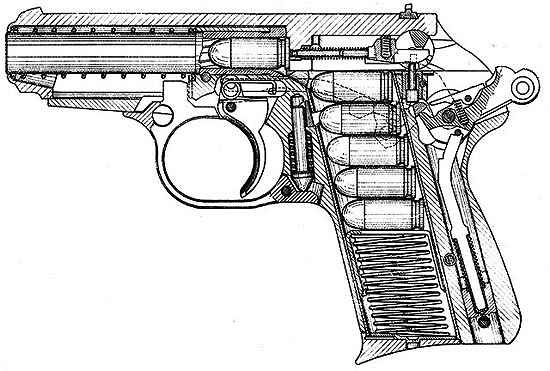
As noted earlier, it's based on the classic Walther PP- but with a very well thought out safety improvements by FEG. Both the FEG and Walther have a hammer block safety that's part of the safety/decocking lever, but the FEG adds a further firing pin safety to the PA-63. If you look at the firing pin of an AP7.65 or PA-63,, you'll note that the firing pin doesn't actually line up with the firing pin. It's only when you pull the trigger (or pull the hammer back on a fully cocked gun) that you'll see the firing pin tilt up so that it's in line with the hammer. That makes cocking very safe. Even if the hammer block fails, the gun will not fire.


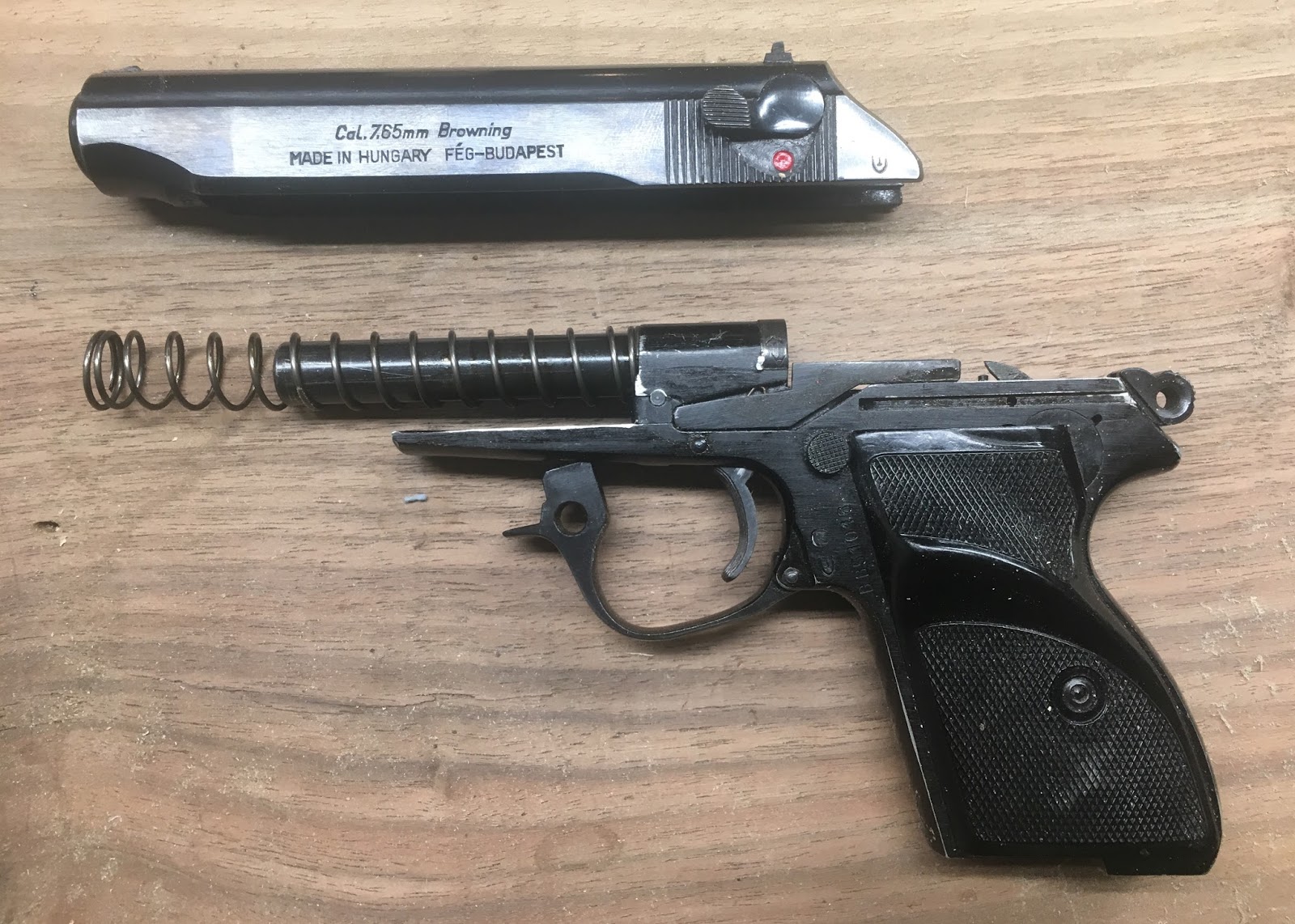
Disassembly is identical to that of the PP series. It begins by pulling down on the trigger guard, which is hinged at the rear\. Pulling it to one side prevents it from springing back into the frame.


See that lug that goes into the frame when the trigger guard is in it's normal position? That stops the slide in its rearward travel under recoil. Once the trigger guard is out of the way, the slide can be pulled beyond its normal travel, the rear of the slide lifted to clear the rails it travels on, and then slid forward and off the gun:


Something I learned after first posting this article: The grips with the thumb rest were not a feature of the pistol originally, and were added for the US market. The reason for that dates back to the 1968 GCA, which established a points system to determine if a gun could be legally imported. The given reason was to ban small, inexpensive guns with "no sporting use." The thumb rest grips are considered a feature of target pistols. Some shooters don't like these, and replacements are available- including original grips removed when these were substituted. 

The bore was clean and shiny, and the ramp showed signs of either oil that had hardened from polymerization, or or perhaps some leftover cosmoline-type coating.  


Part 2 will be about actually firing the AP7.65, but that'll have to wait until (1) I find some .32ACP at a reasonable price and (2) I get to the range. Given that it's almost deer season, and everyone who hasn't fired their gun since last year is lining up to zero and practice, it may be a while before I get there.