Showing posts with label auto. Show all posts

Tuesday, October 31, 2017

The FÉG Model AP7.65 Pistol in .32ACP, Part I


I've been thinning out my collection, getting rid of guns I didn't actually shoot. The last thing I needed was another Soviet-era European pistol... and then I saw that Classic Firearms had received a shipment of FEG AP7.65 pistols... and was selling them at an attractive price. Hmm. I rationalized that I'd sold 5 guns this year and was planning on selling a few more, so there was room in the safe. Plus this pistol had several things going for it:

  1. It was in 7.65 Browning, aka .32ACP, and I'd never owned a pistol in that caliber. 
  2. It was based on the Walther PP.
  3. It has the classic sculpted lines that have disappeared in modern firearms. 
  4. It was only $219.

I ordered one and had it shipped to my local FFL I also opted to spend an additional $20 for special hand selection, which I think paid off:


The slide is in excellent condition, with no scratches or wear to the bluing. The only real wear on the gun is that seen on the barrel through the ejection port. The frame also shows some wear, but that could be expected as the anodized surface isn't as hard as the blued steel slide.

While waiting for the pistol to arrive I did the usual Google searches to learn some more about the gun, and discovered that there's some confusion out there as to the history of the gun. Classic Arms stated that these were police turn-ins, but that may or may not be the case. For one thing, countries under Soviet rule were generally constrained to using pistols firing the 9x18 Makarov, and either used the Russian pistol or developed their own gun in that caliber. The standard Hungarian police gun, developed to accommodate that mandate, was the Reddõrségi Pistoly R61, in 9x18 Makarov, which was based on the Walther PP. A commercial version was also sold in .380 (or 9mm Browning, as it is known in Europe.)

The success of the R61 led to the a request by the Hungarian military for a similar lightweight pistol, and FEG responded with the PA-63, in 9mm Makarov (Piztoly 63 Minta, or PS-63M).  This served as the primary army pistol until the collapse of the Soviet Union, at which time it was replaced by the P93 in NATO standard 9MM Parabellum. That in turn led to the development of a variant of the PA-63, the AP7.65, as an export model.

Some commenters in forums claim that some of these AP7.65s were used by Hungarian police departments, perhaps in an unofficial capacity. Others stare that these were used by paramilitaries, border guards, or other security forces. One source says that they came from Israel, where they were used by the civil police, the Mishteret Yisroel.  Leaving that question aside, let's get back to the details of the gun itself.

The AP7.75 has a steel slide assembly and an aluminum-titanium alloy frame that can be found today in two different cosmetic versions. Mine, as you can see, has a blue or blue-black anodized finish, but it's also available in a "two toned" versions, with a reddish or yellowish anodized frame. I had a choice, and opted for blue, in part because I think it looks better ( and in part because they wanted an extra $20 for the color anodized versions.)

As noted earlier, it's based on the classic Walther PP- but with a very well thought out safety improvements by FEG. Both the FEG and Walther have a hammer block safety that's part of the safety/decocking lever, but the FEG adds a further firing pin safety to the PA-63. If you look at the firing pin of an AP7.65 or PA-63,, you'll note that the firing pin doesn't actually line up with the firing pin. It's only when you pull the trigger (or pull the hammer back on a fully cocked gun) that you'll see the firing pin tilt up so that it's in line with the hammer. That makes cocking very safe. Even if the hammer block fails, the gun will not fire.
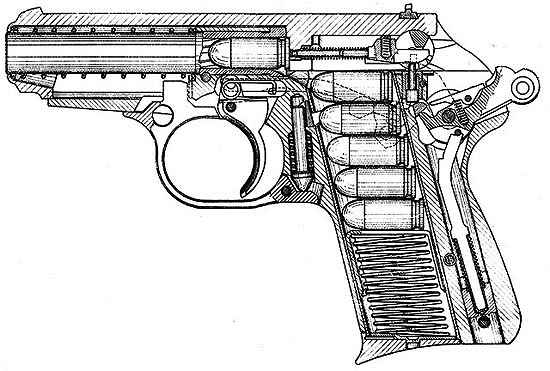

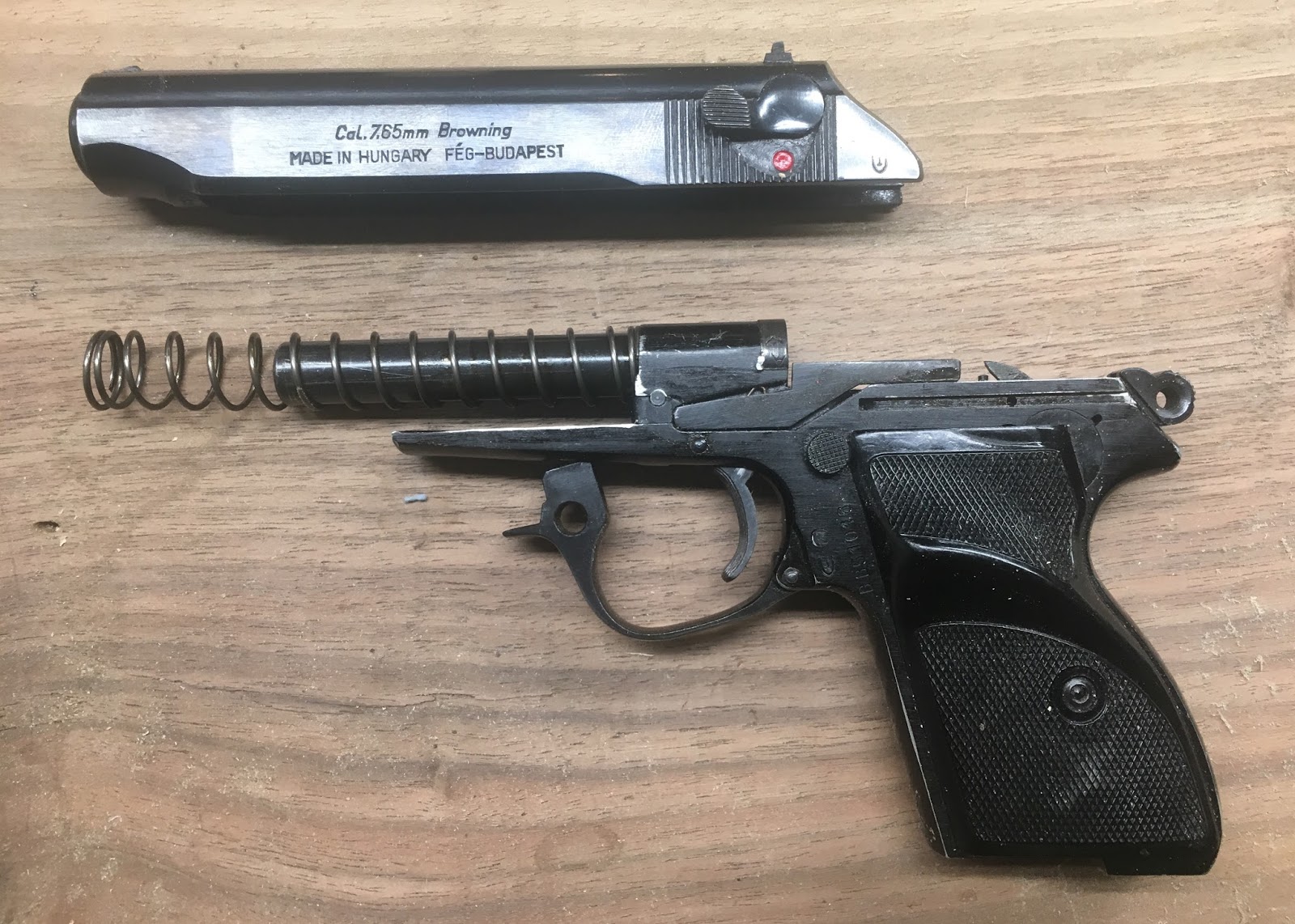
Disassembly is identical to that of the PP series. It begins by pulling down on the trigger guard, which is hinged at the rear\. Pulling it to one side prevents it from springing back into the frame.


See that lug that goes into the frame when the trigger guard is in it's normal position? That stops the slide in its rearward travel under recoil. Once the trigger guard is out of the way, the slide can be pulled beyond its normal travel, the rear of the slide lifted to clear the rails it travels on, and then slid forward and off the gun:

Something I learned after first posting this article: The grips with the thumb rest were not a feature of the pistol originally, and were added for the US market. The reason for that dates back to the 1968 GCA, which established a points system to determine if a gun could be legally imported. The given reason was to ban small, inexpensive guns with "no sporting use." The thumb rest grips are considered a feature of target pistols. Some shooters don't like these, and replacements are available- including original grips removed when these were substituted. 

The bore was clean and shiny, and the ramp showed signs of either oil that had hardened from polymerization, or or perhaps some leftover cosmoline-type coating.  


Part 2 will be about actually firing the AP7.65, but that'll have to wait until (1) I find some .32ACP at a reasonable price and (2) I get to the range. Given that it's almost deer season, and everyone who hasn't fired their gun since last year is lining up to zero and practice, it may be a while before I get there. 


Friday, August 18, 2017

Aimtech APM-11 scope mount for the S&W 422


The Smith & Wesson 422 is an accurate, reliable, fun to shoot pistol, with many of the features that make the more expensive Model 41 so good. You can almost think of the 422 (and its stainless companion, the 622) as an entry level Model 41- in fact, they share the same magazine. They both have a very low bore axis, just above the grip. The ejection port is at the top of the grip, and the entire slide is actually above the bore and the port. That low bore axis means that recoil is almost straight back- there's very little rotation of the gun when fired. 

The 422 came in two versions, one with fixed sights (which I have) and a nicer one with adjustable sights and wooden grips. You can't just swap sights, either, as you can with many pistols. While the rear sight on the fixed model is simply dovetailed into the slide, on the adjustable model, the slide is actually milled longitudinally for the sight. I thought about fitting a a sight from another gun onto my 422, but that leaves the problem of the front sight, which I think is an integral part of the alloy frame, and can't be replaced. You'd have to solder or epoxy some sort of extension on. 

That led me to think about putting a dot sight on it. There's no provision in the pistol for mounting a scope, though some have milled slots into the upper part of the frame, just behind the front sight, or mounted a short rail there. The simpler solution is to get an APM-11 mount from Aimtech, who make scope mounts for all sorts of difficult to scope pistols. This will cost you around $65-68 with postage, depending on where you order it. I paid $68 from Optics Planet, as while there were cheaper listings out there, they were all from shops I'd never heard of, and I'd done business with Optics Planet and trusted them. 


As you can see from the photo at the top of this article, the APM-11 mounts by replacing the right hand side grip. It's a very secure mount, similar to Aimtech's mount for the Colt 1911. The mount itself is made of thick, anodized, aluminum that doesn't flex at all. It's a very high mount, that leaves plenty of room between the gun and scope- enough to use the stock sights, if you like:


although it does help make the gun more top heavy. The scope and mount add enough weight that the combined  assembly is a lot harder to shoot bullseye style than the gun alone. I spent a few hours this afternoon shooting 3 foot-pound Aguila Colibri rounds into my basement pellet trap to get a feel for how it handles, and had a real preference for two-handed shooting with this setup. I may try it with a smaller, lighter dot sight. 

One thing that did strike me was the finish on this piece- it's rough. Take a look:


This isn't just an unpolished finish. It's as if part of their anodization preparation involves tumbling parts with  nuts, bolts and old metal roller skates. In fact, it got me to wondering if perhaps Optics Planet hadn't sent me a used unit, so I sent them a note asking about this. They replied with an apology, and an offer to send it back or accept an $18 price adjustment. I took the price adjustment. 

Overall, I'm impressed with the accuracy of the machining (and less so for the finishing) and how well it fits the gun. On the minus side, it's a bullseye sight mount that's not really a bullseye grip, though a clever gunsmith or shooter could screw or epoxy half a wood grip to it, I suppose. I can't imagine using it for anything other than bullseye or other target shooting at known distances, given how high the mount is above the bore axis. 

Tuesday, June 20, 2017

The CZ83 in .380, Part II: Shooting


Not too long after receiving my CZ83 I took it to a local outdoor range to see how it actually shot. I had a fair amount of .380 practice ammunition on hand, but as this was originally a Soviet-era pistol (the 9mm Makarov CZ82 version entered Czech military service in 1983) I decided to try some Soviet, or at least Russian, ammunition. I found steel cased and jacketed Tula for around $14/50 and decided to see how well that worked in the CZ. 

In brief, it worked perfectly. No failures to feed or to eject. Firing behavior is harsh, as you'd expect from a fixed barrel, straight blowback gun. It's not as unpleasant at a PPK in .380, which is what you'd expect, as this is a significantly heavier pistol (32 ounces to the PPK's 23.5) but it's certainly not enjoyable. A well-fitting set of grips would probably help, and I'm still considering ordering a set from grips4u. 

As for accuracy- it's pretty good for what is intended as strictly a self-defense pistol. I set up a standard silhouette target at 25 yards and as you can see below, I managed to keep all my shots on the target- roughly in a 10" circle. If you exclude my first few shots, taken as I was getting used to it, most of my shots fell within a 5" circle. With practice I suspect I could tighten my groups significantly.  I'd also like to compare the performance of the TULA ammunition with brass-cased ammunition. 


My shots tended to hit around 4-5" left of center. That may be due to the sights not being aligned properly, or it may be me pulling the shots left from poor trigger control. Regardless, accuracy is more than good enough for the purpose it was designed for. 

In my original post on this pistol I mentioned that it was one of a batch of pistols that was recently imported, and I decided that if I had any interest in it I ought to jump on it before they disappeared and prices went up. Well, it's been just about two weeks since I ordered mine, and none of the suppliers who were offering them two weeks ago have any in stock. More may be coming in eventually, but for the moment, if you want one, you'll probably have to pay more than you did two weeks ago. 

UPDATE:

Since writing this, I've learned that the Czech police phased out the CZ 82 (the 9x18 Makarov version of the pistol) from service after discovering that it's not drop safe. Even though the  rebounding hammer cannot normally hit the firing pin unless the trigger is pulled, it is possible for the slide to bounce in such a way that it brings the cartridge into contact with the firing pin. The Czechs ordered that CZ 82s should be carried with the hammer down on an empty chamber until they were all removed from service

Friday, April 28, 2017

The Polish P83 Wanad in 9x18 Makarov - Part II


In my last post on the P83 Wanad three months ago I talked about the gun itself, its history, and how it disassembles. Today I finally managed a trip to the range with the pistol (and a few others). As you can see above I took a few boxes of Geco 9x18 Makarov ammunition that I chose in part because it was the cheapest I could find. After all, a reliable pistol designed for combat use shouldn't be picky about ammunition- and this one wasn't picky. Every shot fed and ejected perfectly. As to accuracy...

Fixed barrel pistol like the P-83, P-64, and Walther's PP family are (or should be)  intrinsically more accurate than delayed recoil pistols like the John Browning designed 1911 pistol. In a 1911, the barrel  moves rearward and down with every shot, and depends on the mainspring and the tight fit of the moving parts to return to its initial position. Tiny difference in position on successive shots  can make a big difference downrange, which is why the gunsmiths who tune the 1911 for bullseye competition spend most of their time tightening up all the tolerances and polishing barrel bushings. The fixed barrel on the P-83, on the other hand,  is in exactly the same position for every shot.


The target above was shot outdoors at 50'. It was a moderately windy day, around 66 degrees. My first shot missed the target entirely. You can see a few shots on the bull,  a few below, and many more high and to the right. The gun was shooting about a foot low and 8 inches right at 50', and I had to walk the shots onto the bull, starting in the upper right corner of the silhouette target. That's not really a big issue as the sights can be moved or filed. I'd like to get it shooting to point of aim at 25 yards.

Firing behavior was sharp, but not terribly uncomfortable. My hands weren't at all sore after 50 rounds fired slowly over half an hour. Double action is heavy but smooth, and single action is light and crisp, with no creep at all on my sample. The safety/decocker is difficult to reach, but the heavy DA pull means that this pistol, like the PPK, can safely be carried uncocked with the safety off.  The grips look and feel rugged enough, but their shape doesn't make it easy to get a good, repeatable, hand position. I'm thinking of ordering a set of wood grips ($69) from Grips4U.net, where they have wood grips for 122 different classic European and American pistols.

On the whole I like this pistol a lot. It's very reliable, and ammunition isn't expensive- the Geco can typically be had for $15-16 a box of 50, and the steel cased Russian Brown Bear and Silver Bear can usually be had for for between $8 and $9 for a box of 50.  Its good enough to be issued to Russian troops, so I assume it's reliable. The P-83 is not only reliable enough to use as a carry piece, it's also a great historic collectable, and I suspect the price will go up when the current supply runs out- remember when Nagant revolvers were selling for $119? Next time out I'm going to work on zeroing the sights and then I can test for accuracy.

Tuesday, December 6, 2016

The New Walther PPK/S in .22


Back in the early days of this blog I wrote about my .380 Walther PPK built under license by Smith & Wesson. I've always been a big fan of the PP and its various derivatives, as it was the model for so many guns that followed. All the Russian Makarov autos are really clones of the PPK  as are just about every other fixed barrel double/single auto pistol. But as much as I liked it, I sold the PPK as I just couldn't get used to the sharp recoil. The PPK was designed around the .32 ACP (aka 7.62 auto pistol) and that's the best cartridge for that gun.

I've been looking for a .32 PPK since then, and then the other day I spotted what turned out to be a used PPK/S in .22 at a very attractive price- and in what looked like unused condition. This is a relatively recent gun from Walther that differs from the earlier .22 PP-type pistols in one significant way. The original guns were of all steel construction, like the centerfire PPs and PPKs, but in order to make the slide light enough to operate with .22LR levels of energy, it had to be thinned to the point that failures occurred at weak points. For this new version, Walther has chosen to use Zamak, a zinc alloy that's lighter than steel and allows Walther to make the slide as thick as the centerfire versions. Zamak has gotten a lot of bad press, mostly because it and other zinc alloys have long been the choice of makers of very cheaply made guns. But used properly it's a good material that should hold up in use, and in the years this pistol has been in the marketplace there haven't been any reports of slide failures. 

It looks and functions just like any PP-family gun, it's accurate enough for plinking, and it's fun to shoot. I put about 100 rounds of CCI Standard Velocity (my all around go-to quality .22) as well as some high velocity Federal Automatch. I had a few FTE failures with the CCI-SV but this is an almost brand new gun that hasn't even been broken in. The single action trigger pull is not too high, but the double action trigger pull is one of the highest of any gun I've fired (including the Nagant revolver!) This is something characteristic of a lot of double-action .22s, as rimfire primers require a stronger hit than do centerfire primers, but the PPK/S is significantly higher than, say, my Beretta Bobcat 21a. I'll keep it for a while, put some more rounds through it, and eventually sell it and move on to something else.

Footnote: If you're confused by the PP, PPK, PPK/S nomenclature, it's really pretty simple. Walther designed the original PP (Polizepistol) in 1929. This was followed in 1930 by the PPK (Polizepistole Kriminalmodel) which was not for criminals but for detectives- those in the kriminal division. 

The Gun Control Act of 1968 banned the import of the popular PPK as it was too small to qualify for import under the (somewhat arbitrary) points system implemented by the law. Walther responded by creating the PPK/S which combined the shorter barrel of the PPK with a longer grip- just long enough to earn enough points for import.

Thursday, May 21, 2015

1980 High Standard Supermatic Citation Military, Part I


After playing with my newly-aquired High Standard Duramatic for a week, I was both impressed with the quality of what was sold as a budget .22 and very interested in finding one of their competition guns. Prices for the Victors and 10X guns, which were High Standard's best and most accurate,  run $800-$1,200 and more, with especially collectable models going for several thousands of dollars, but the various Supermatics are very affordable.

There were so many different High Standard models it's sometimes hard to keep track. Add to that the evolution of the designs over 30 years and it gets even more confusing, but this is an (over) simplified and incomplete list of models that probably misses number of details:

1. Top level competition guns: Victor, 10x, Olympic.

2. Competition guns: Supermatic Tournament, Supermatic Citation, and Supermatic Trophy. 

3. Fixed sight guns: Sharpshooter, Field King and Sport King

4. Budget model: Duramatic

HS produced several successive generations of guns between the 50s and the 80s, ranging from the "Letter" models, through the numbered series (101 through 104, 106, and 107) and finally the SH series, the last series made, and the basis of the contemporary High Standards. The earliest guns used a hammer action; later guns use a striker mechanism. Guns through the 105 series have a more angled grip, similar to the Ruger Mark guns. The 106, 107, and SH series guns use the so-called "Military" grip that matches the 1911 in angle. The Olympic was a Supermatic version designed for Olympic rapid fire competition that was chambered for the .22 Short cartridge and had a muzzle brake. 

This particular gun is a 107 Series, made in 1980, according to the records. It's in exceptional condition, with almost 100% of its blue and only a few nicks and scratches. The two stage trigger breaks cleanly, with just a minuscule amount of creep that could probably be eliminated by a good gunsmith or perhaps better lubrication. There's too much over travel in the trigger, too; there's a screw in the trigger to limit that, but it looks like it hasn't been adjusted by the previous owner:


One thing I like about older guns is the amount of visible hand work of the sort that's just about unaffordable these days in factory guns. Take a look at the stippling on the front of the grip:


That's done with a hammer and a punch, and it takes time. There is similar stippling on the rear of the grip. Everything about this gun tells you it was made by gunsmiths, not just machine operators.

The sights are the best iron sights on any gun I've ever owned- sharp edges, perfectly square, and sized so you get a narrow band of light either side of the front post that makes it easier to center. I took the gun to my club's indoor range, and got these results with Aguila Pistol Match shooting two handed, resting my arms on my shooting bag:


That's with the gun right out of the box, as I bought it. It probably hadn't been fired in years, from the looks of it. My offhand shooting was not quite as good ;-)


Real bullseye shooters will not be impressed, but me, I'm thrilled that I got five out of ten in the black. Besides having a pretty wide wobble, I'm obviously pulling the trigger too hard; over travel adjustment should help that. Next step is to do a proper clean and lube, and mount a red dot sight to accommodate

Update: I took it to the range again, after some air pistol practice at home, and shot much better with it, getting all my shots in the black. Surprisingly (or perhaps not) I shot it better with the stock iron sights than I shot my tuned and customized Ruger Hunter (which sports a Volquartsen trigger, Clark hammer, and Herrett target grips). I think the Ruger might go up for sale soon.