Showing posts with label automatic. Show all posts

Monday, December 4, 2017

A rusty and pitted CZ 70 in .32 acp - Part I


Several weeks ago I ordered a CZ-70 in 7.62 Browning, aka .32acp, from Classic Firearms and had it shipped to my local FFL I paid the extra $20 for a hand-selected example, based on my previous dealings with Classic, and assuming it would be in as good condition as the FEG 7.62 and the CZ 83 I wrote about earlier. That, it turned out, was an incorrect assumption. 


The gun that arrived was pitted and covered in rust. It was so rusted and gummed up that I couldn't even depress the magazine release, which it why you see it with the slide back in the above photo. My hand were covered in rust, as was the bag it arrived in. I took it home and sprayed it with plenty of my homemade Ed's Red to displace moisture and halt the rusting, and sent a friendly reply to Classic in response to their "how did we do?" email.


That was a week ago. Several days later, having heard nothing, I went to work on the gun. The first step was try try and disassemble it.  I began by removing the plastic grips and setting them aside. Using a brass punch and a hammer I managed to depress the magazine release, but the magazine still didn't want to come out. Using a rag and a pair of pliers I pulled it, and- no surprise- it was covered in rust, as was the inside of the frame.


Again using the hammer and punch I managed to depress the slide release, and completed the basic field stripping of the gun. Not having a good disassembly manual or exploded diagram I stopped there and set everything to soak in more Ed's Red. 

Over the next two days I went at the gun with solvents, #0000 steel wool, brass wool, stainless steel and bronze brushes, and 500 grit paper for rust inside the slide. I also cleaned the grips and gave them a quick buffing on a rag wheel. 

One of the most difficult parts was freeing up the firing pin, which was frozen solid. I seemed to be jammed with a mixture of heavily oxidized grease or perhaps cosmoline, and a fine grey powder- no idea what that was. I didn't want to completely disassemble the slide, so for now I flushed the firing pin with solvent, through the opening for the firing pin lock, until the pin moved freely, and then i filled the are with light oil for now. I imagine I'll eventually want to actually disassemble that area. There's a drive pin visible in this photo (upper left)  that I think holds the firing pin and spring in place. 


After several hours of work I managed to get rid of all the visible rust, but not the pitting, of course. That'll have to wait for some long boring winter nights when I'll feel like completely disassembling it and draw filing, sanding, buffing, and rebluing it. For now, though, I've arrested and removed the rust. It looks safe to shoot, with no obvious cracks in the frame, but I'm going to wait until I can do a really thorough teardown. 


UPDATE: Still working on the gun. I haven't fired it yet, as I'm not entirely sure if it's safe; there may be cracks in the frame. 

And a month after my email, I still have not received a reply from Classic Firearms. 

Tuesday, December 6, 2016

The New Walther PPK/S in .22


Back in the early days of this blog I wrote about my .380 Walther PPK built under license by Smith & Wesson. I've always been a big fan of the PP and its various derivatives, as it was the model for so many guns that followed. All the Russian Makarov autos are really clones of the PPK  as are just about every other fixed barrel double/single auto pistol. But as much as I liked it, I sold the PPK as I just couldn't get used to the sharp recoil. The PPK was designed around the .32 ACP (aka 7.62 auto pistol) and that's the best cartridge for that gun.

I've been looking for a .32 PPK since then, and then the other day I spotted what turned out to be a used PPK/S in .22 at a very attractive price- and in what looked like unused condition. This is a relatively recent gun from Walther that differs from the earlier .22 PP-type pistols in one significant way. The original guns were of all steel construction, like the centerfire PPs and PPKs, but in order to make the slide light enough to operate with .22LR levels of energy, it had to be thinned to the point that failures occurred at weak points. For this new version, Walther has chosen to use Zamak, a zinc alloy that's lighter than steel and allows Walther to make the slide as thick as the centerfire versions. Zamak has gotten a lot of bad press, mostly because it and other zinc alloys have long been the choice of makers of very cheaply made guns. But used properly it's a good material that should hold up in use, and in the years this pistol has been in the marketplace there haven't been any reports of slide failures. 

It looks and functions just like any PP-family gun, it's accurate enough for plinking, and it's fun to shoot. I put about 100 rounds of CCI Standard Velocity (my all around go-to quality .22) as well as some high velocity Federal Automatch. I had a few FTE failures with the CCI-SV but this is an almost brand new gun that hasn't even been broken in. The single action trigger pull is not too high, but the double action trigger pull is one of the highest of any gun I've fired (including the Nagant revolver!) This is something characteristic of a lot of double-action .22s, as rimfire primers require a stronger hit than do centerfire primers, but the PPK/S is significantly higher than, say, my Beretta Bobcat 21a. I'll keep it for a while, put some more rounds through it, and eventually sell it and move on to something else.

Footnote: If you're confused by the PP, PPK, PPK/S nomenclature, it's really pretty simple. Walther designed the original PP (Polizepistol) in 1929. This was followed in 1930 by the PPK (Polizepistole Kriminalmodel) which was not for criminals but for detectives- those in the kriminal division. 

The Gun Control Act of 1968 banned the import of the popular PPK as it was too small to qualify for import under the (somewhat arbitrary) points system implemented by the law. Walther responded by creating the PPK/S which combined the shorter barrel of the PPK with a longer grip- just long enough to earn enough points for import.

Saturday, June 27, 2015

The Smith & Wesson 422


I'd been reading about the now-discontinued Smith & Wesson 442 and its relatives (622, 2013, 2206) in one of my favorite rimfire forums, and that encouraged me to go looking for one. After a  few weeks of searching I managed to find a relatively inexpensive 422 with fixed sights.

The various versions of this pistol could be had with aluminum, steel, or stainless steel frames, with 4" or 6" barrels, and with fixed or adjustable sights. The 422 is one of the least expensive variants, with an aluminum frame and fixed sights. That would seem to relegate it to the role of inexpensive plinker, but that isn't actually the case- as we'll see shortly.


The muzzle reveals an interesting detail of the construction of the 422: A threaded barrel held in place by a nut:


This system of attachment holds the barrel in tension, which is a good way to achieve accuracy in a short, light, barrel. The Dan Wesson revolvers made in the 80s used this system, and my Dan Wesson .44 was one of the most accurate center fire revolvers I've owned. It has a secondary benefit as well: Threaded adapters that replace the barrel nut are available from a few gunsmiths and class III dealers that allow a silencer to be attached.

Pulling back on the slide (which locks open on an empty magazine) we see what looks like the breech opening on top of the gun- but a close look indicates that's not the case:


This can be a bit puzzling to first time 422 handlers until they remember that the magazine is located in the grip, and look there:


Note that the barrel is located very low in the receiver- just above the trigger, in fact. That's a common characteristic of high end target pistols and it produces straight-line recoil and minimizes barrel lift, something thats very important in timed and rapid fire stages, when you're trying to get back on target as soon as possible after each shot. It also minimizes the perception of recoil. 

A lot of people don't like the magazine release, which is right smack in the middle of the grip frame:


I like it. I found it easy to release, and not at all prone to accidental release.

Those familiar with the S&W 41 may note a strong resemblance, and that's because design of the 422 and related guns is a simplified version of S&W's high-end Model 41 target pistol, with lighter materials and a nonadjustable trigger. The similarity is such that the 422 takes exactly the same magazines as the 41, which means there are plenty of new and used magazines available. 

Being mainly aluminum, the 422 is pretty lightweight- the 6" version weighs only 23.5 ounces, compared to the 42 ounces of a Ruger Mk-III Target- and you'd think that would mean it's not as accurate or easy to shoot as a heavier gun. That may be true, but this is  very easy to shoot, and very accurate gun all things considered. I took it to my club and set up a few targets at 50'. My first two shots went right where I was aiming:


That's  lot better than I usually shoot, and that's with iron sights. The fixed sights were dead on at 50' and I'm guessing that should be pretty close at 25 yards. Back in the 1950s you could probably have been a competitive shooter with this gun. I'd been thinking about mounting a dot sight, but I think I'm going to leave it exactly as is. Given the light weight and great accuracy, it's a great gun to pack afield. Of course now that my appetite has been whetted for these guns I'm looking for more variations, starting with an adjustable sight 2206, and maybe even a Model 41. 

Wednesday, May 13, 2015

High Standard Duramatic M101: First impressions


While most of my collection consists of revolvers, I have long been a fan of the old High Standard pistols, which combined solid steel construction with great reliability and accuracy. While I'd like to find one of their high end competition pistols at an affordable price,  I'm no less a fan of their lower end pistols- like this Duramatic M101 that caught my eye at the local Cabelas. This is one of the cheapest High Standard .22s, but it's just as solid and well made as the better guns, and it came with the original box and all the original paperwork. I managed to negotiate the price down $50 from the asking price (it had been there for a while) and it followed me home.


This pistol is very well designed, with a lot of attention given to service and maintenance. The safety is a simple cross bolt, located in the rear of the receiver, that performs several functions. 


See those two notches in the slide? The rearmost one is engaged by the cross bolt when the slide is forward, locking the slide in place. The forward notch is used for locking the slide open, as you see in the photo above.

Once the slide is locked open, turning the large wheel in front of the trigger guard loosens the screw holding the barrel in place. This is very different from just about every other HS pistol, which all used a push-button barrel release, like the S&W 41 and 23A.


One the barrel is removed, the slide can be removed by simply sliding it forward:


Note that the striker/firing pin is in the fully cocked position, held in place by the sear; locking the slide back also cocked the striker. Don't touch the trigger while the gun is disassembled unless you want to see the striker shoot forward with a lot of force! (I accidentally did that the next time I had the gun disassembled for cleaning. Now I put the safety back on after moving the slide.) The rear end of the striker is painted red, and protrudes slightly out the back of the receiver when cocked, giving a nice visual indication.


Once the slide and barrel are off you can loosen the trigger guard retaining screw (just a few turns are needed) and the screw that holds the grip in place and remove the grip. At that point you'll notice that there's no metal grip that's part of the frame; the plastic grip is both the band grip, and the support for the magazine! I like to remove it when cleaning the gun as I'm concerned that some of the solvents used in cleaning might attack the plastic. (If you do manage to damage the plastic grip, all is not lost; modern replacements are being made from the original mods and can be had for $50 or so.)


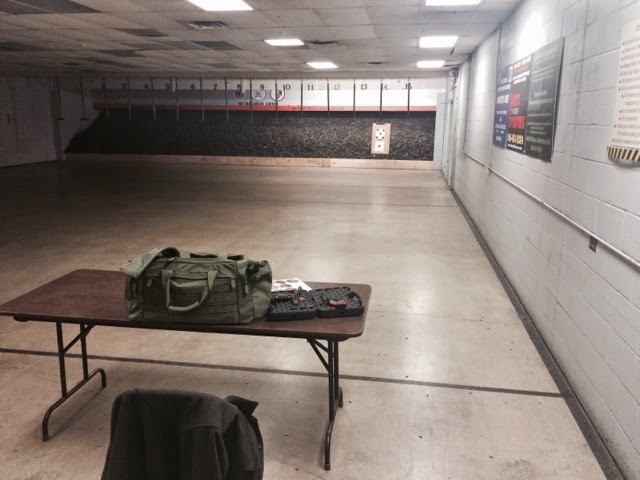
I brought the carefully cleaned, lubed, and reassembled gun to my club this morning, early enough that I had the indoor 50 foot range to myself for several hours, so I was able to do testing at distances from a few yards to the full 50 feet. I used several different standard velocity .22LR cartridges, including CCI Standard Velocity, Federal Match, Federal Auto Match, Aguila Pistol Match, Wolf Match, SK Match, and Aguila SSS 60gr. The gun functioned flawlessly with everything for the first hundred or so rounds, but as it got dirtier some of the rounds didn't feed as well, and the bullets hung up on the feed ramp. 


Accuracy was hard to judge, as the gun shot several inches high at 50' with the ammunition I was using. The rear sight is a battered-looking thing with no adjustment, so I was stuck with that for the moment. It did seem to group reasonably well; I plan on going back with more targets and a brass hammer and punch so I can move the rear sight. I might even find a small adjustable sight I can install.


I have to say I really like the feel of this gun. The all-steel construction goes it a feeling of solidity and mass you just don't see in many other .22 auto pistols. Shooting it made me think I might want to get one of High Standard's actual match pistols, and that started me looking around. What I found will be in the next blog entry.

Postscript: Six months after buying this pistol I sold it. I was tempted to keep it, as it's a beautiful example of the kind of design and solid construction you simply don't see in modern pistols, but I only have so much room.  I also have a really nice High Standard Supermatic Citation now that's the most accurate and the best shooting pistol I've ever owned.

There is one  modern pistol that's built the way they used to be built, and that's because it's the grandfather of all modern auto pistols: The 1911. The best ones still have that solid feel and give the impression that they were milled from a block of steel- because they were. I've never owned a 1911, but I've always wanted either a standard Government model or a serious wadcutter target model.


Wednesday, April 8, 2015

Herrett Nationals bullseye stocks for the Ruger Mk-III


The last time we saw this gun (Ruger Mark-III Hunter) it was sporting a set of Volquartsen molded plastic grips and a silver Ultradot sight. I sold the Ultradot as I was shooting this pistol with iron sights, but recently I mounted another dot sight (Millett SP-1) and purchased a set of Herrett Nationals grips. These can be a bit hard to find; not many retailers carry them, and Bullseyegear.com has had them on back order for a long time. But I found a set at a good price ($69 + $5.95 shipping) on eBay and they arrived a few days ago.

I took the newly configured pistol to my club yesterday and spent about an hour on the 25 yard outdoor range with the Herrett-equipped Ruger and a box of the Federal Auto Match I bought at Field & Stream last week. First impressions are that these grips are definitely easier to hold steady than most previous grips I've tried. The palm self makes it easier to get a solid grip without excessive gripping force that can make the hand tense up. A light squeeze in the grip causes the hand to push down on the shelf, which pushes the muzzle up.

The screws that hold the shelf in place are not as secure as I'd like; I may add some star washers, or perhaps a couple of pins to better secure the shelf. But overall I like it. My XL-sized hands require that the shelf is set almost at the bottom of its travel. Those with hands significantly smaller than mine have reported that they can't set the shelf high enough for a good grip, but some small handed target shooters have added padding to the shelf to fix this.

As for the Federal, it all fed without any problems (I fired around 100 rounds). I can't give any real reading on the accuracy, as it was pretty windy that day. I plan on shooting some indoors from this gun next week, and that should give me a better idea. Reports from other shooters say it's a lot more consistent than most bulk-pack .22LR, but certainly not up there with the low end match ammo like Ely Club; it might be in the same class as good old CCI Standard Velocity. I'll reserve some for comparison with other ammunition in my Anschutz and my custom 10/22.

Thursday, February 3, 2011

Airguns for Pistol Practice


I'm a great proponent of airguns- not just for simulated firearms practice, but for shooting in their own right. I shot Airgun Field Target for several years,  I have an airgun blog, and I use air rifles for small game hunting. The gun shown above, though, I bought specifically for firearms simulation and training. It's a Makarov replica, and it's very close in size, design, and weight to the actual gun.

This is the second version of the Makarov BB pistol made. The first was made in the same Russian factory that produced the Makarovs, and was dreamed up as a way to use up the surplus frames and other parts after production of the pistol was discontinued. It was not a cheap gun, selling for over $100, but it was probably the best BB pistol ever made. It was so much like the firearm version that the BATF decided it could be converted into an actual pistol without too much effort (though I don't know that this ever actually happened)  and so after two years of production it was banned. If you can find one, expect to pay at least $200 for it.

The Umarex-made Makarov CO2 BB Pistol air pistol replica seen above sells for a more reasonable $59, and has a working slide and safety lever that closely mimics the functioning of the firearm. Pulling back the slide cocks the hammer, and the safety locks the gun so it can't be fired or cocked. BBs load via a magazine that slides into the grip, just like a magazine on the real gun. If the hammer isn't cocked, it fired with a realistic double-action trigger pull.

If you're just getting started with pistols, or introducing a family member to shooting, something like this is a good way to teach safe gun handling at home, with low risk of injury. Eye protection and a good backstop are still necessary, of course.

Sunday, January 23, 2011

The Bernardelli 60


The Bernardelli 60 is a perfect example of the kind of "pocket pistol" that was once very common here and abroad, but was killed off by the Gun Control Act of 1968.  This particular gun came from the estate of a good friend and mentor, who taught me just about everything I know about fly fishing and bird hunting. It was first made in 1959, and could be had in .22LR, .32ACP or .380 versions.

The 60 failed the new post-68 laws on account of being just a bit too small, and not having various sporting-appropriate features as defined in the GCA. Bernardelli replaced it with the Model 80, which was otherwise identical but included a de-cocking lever and grips with a molded in thumb rest, which gave it more points under the GCA import restrictions. (The thumb rest made it more of a "target pistol.) The 80 was made into the 1970s.

It was once common for fishermen and hunters to carry a small .22 pistol, the classic example being the Smith & Wesson .22/.32 Kit Gun. You might be on a fishing trip, or deer hunting, traipsing through the woods, when you'd come across a rabbit or a grouse you could bag for that evening's dinner. Or you might need to administer a coup de grace to a wounded animal. A gun like the 60 could come in handy.

But rules and regulations changed, and carrying a .22 in your pocket, even in the woods, became a felony. Game seasons were tightened up, and the typical deer hunter was as likely to be staying in a motel as in a wall tent. And tastes changed. The classic styling of this pistol evokes an earlier time; these days, the popular style seems to be squared off guns with hard edges. The only high quality guns still on the market that evoke this style, as far as I know, are the SIG 232 and the various Walther PPK variants. (There are still a few cheap guns based on old designs, like the Jimenez and Jennings .22 pistols.)

This is, incidentally, a fantastic pistol in .22. Recoil is modest, as you might expect, and accuracy is exceptionally good for a simple auto with fixed sights. The only flaw, to a modern shooter, is the heel magazine release. It's much slower to use than a button release and it makes it hard to reload. Based on my experience with the PPK and other straight blowback pistols in .380, I would think a model 60 in that caliber would be very unpleasant to shoot. A .32 would probably be comfortable enough.

As  I mentioned, this particular pistol came from a friend's estate, and was given to me. I brought it to the range (after complying with my state's registration laws) and put a few bricks of CCI Minimags through it. It's a pretty accurate shooter, despite the tiny fixed sights. At  25' I could keep all my shots in a 6" circle, which was not too shabby considering the dim lighting and the tiny sights. It spends most of its time in the safe, but still comes out occasionally to accompany me on jaunts through the woods.

Update: Here's an ad from the 1960s for the Model 60 I found while searching for more information on the pistol:


A web search for more information led me to the July 1971 issue of The American Rifleman, and this two-page piece on maintenance and assembly/disassembly of the 60. I then found a used copy for sale and scanned that in. I hope my readers appreciate the ends I go to for them! ;-)