Friday, August 18, 2017

Aimtech APM-11 scope mount for the S&W 422


The Smith & Wesson 422 is an accurate, reliable, fun to shoot pistol, with many of the features that make the more expensive Model 41 so good. You can almost think of the 422 (and its stainless companion, the 622) as an entry level Model 41- in fact, they share the same magazine. They both have a very low bore axis, just above the grip. The ejection port is at the top of the grip, and the entire slide is actually above the bore and the port. That low bore axis means that recoil is almost straight back- there's very little rotation of the gun when fired. 

The 422 came in two versions, one with fixed sights (which I have) and a nicer one with adjustable sights and wooden grips. You can't just swap sights, either, as you can with many pistols. While the rear sight on the fixed model is simply dovetailed into the slide, on the adjustable model, the slide is actually milled longitudinally for the sight. I thought about fitting a a sight from another gun onto my 422, but that leaves the problem of the front sight, which I think is an integral part of the alloy frame, and can't be replaced. You'd have to solder or epoxy some sort of extension on. 

That led me to think about putting a dot sight on it. There's no provision in the pistol for mounting a scope, though some have milled slots into the upper part of the frame, just behind the front sight, or mounted a short rail there. The simpler solution is to get an APM-11 mount from Aimtech, who make scope mounts for all sorts of difficult to scope pistols. This will cost you around $65-68 with postage, depending on where you order it. I paid $68 from Optics Planet, as while there were cheaper listings out there, they were all from shops I'd never heard of, and I'd done business with Optics Planet and trusted them. 


As you can see from the photo at the top of this article, the APM-11 mounts by replacing the right hand side grip. It's a very secure mount, similar to Aimtech's mount for the Colt 1911. The mount itself is made of thick, anodized, aluminum that doesn't flex at all. It's a very high mount, that leaves plenty of room between the gun and scope- enough to use the stock sights, if you like:


although it does help make the gun more top heavy. The scope and mount add enough weight that the combined  assembly is a lot harder to shoot bullseye style than the gun alone. I spent a few hours this afternoon shooting 3 foot-pound Aguila Colibri rounds into my basement pellet trap to get a feel for how it handles, and had a real preference for two-handed shooting with this setup. I may try it with a smaller, lighter dot sight. 

One thing that did strike me was the finish on this piece- it's rough. Take a look:


This isn't just an unpolished finish. It's as if part of their anodization preparation involves tumbling parts with  nuts, bolts and old metal roller skates. In fact, it got me to wondering if perhaps Optics Planet hadn't sent me a used unit, so I sent them a note asking about this. They replied with an apology, and an offer to send it back or accept an $18 price adjustment. I took the price adjustment. 

Overall, I'm impressed with the accuracy of the machining (and less so for the finishing) and how well it fits the gun. On the minus side, it's a bullseye sight mount that's not really a bullseye grip, though a clever gunsmith or shooter could screw or epoxy half a wood grip to it, I suppose. I can't imagine using it for anything other than bullseye or other target shooting at known distances, given how high the mount is above the bore axis. 

Saturday, July 29, 2017

Ed's Red


What's your favorite all-in-one gun cleaner, lube, and protectant? An awful lot of shooters, as well as the US Military, use Break Free CLP. Some shooters like Ballistol, which was formulated for the German military around the time of the First World War.

There are also a number of expensive "superlubes" that show up on the market from time to time, like Fireclean, which sells for $15 per 2oz bottle ($7.50 per ounce) and promises to have all sorts of wonderful properties, like being biodegradable, non-toxic, removing baked-on carbon, and providing lubrication even when there's no visible lube left on the gun. Thanks to a number of dedicated Internet researchers, we know that Fireclean is mostly (or entirely) vegetable oil, which sells for about twenty cents per ounce at my local grocery. (If you follow this link, you can see Ian McCollum and Karl Kasarda frying eggs in Fireclean.)

Way back in 1947, retired US Major General Julian Hatcher published his"Hatcher Notebook,"  a collection of essays covering just about everything he knew about guns and marksmanship, and in that book he listed a formula for "Frankford Arsenal Cleaner No. 18," a mixture that dated back at least to the 1920s. Hatcher's formula consisted of equal parts sperm whale oil, Pratts Astral Oil, turpentine, and acetone, and optionally, some lanolin added.

Sperm whale oil isn't available today, but a modern substitute is: Automatic Transmission Fluid. Pratt's Astral Oil turns out to have been deodorized kerosene, which is sold today as lamp oil. Turpentine is expensive, can break down, and has a strong odor, but there's a modern substitute for that as well: Stoddard Solvent, also known as odorless mineral spirits. With all the plastic grips and other parts in guns today the use of acetone in a general purpose gun cleaner probably isn't wise. But the remaining ingredients still make for a good general purpose CLP formula, and in 1991 C. E. "Ed" Harris published his modernized formula, which has come to be known as Ed's Red. Very simply, it's composed of:

1 part ATF
1 part odorless kerosene or lamp oil
1 part odorless mineral spirits
200 grams anhydrous lanolin per liter of mixture. (optional)

Ed recommended adding 1 part acetone, as in the original formula, for removing plastic residue from shotgun barrels, or aggressive powder residue removal. I'd skip the acetone for the reasons I mentioned previously.

I mixed up a batch today from material on hand, although I did drop by my local hardware store to get a chemical-resistant spray bottle. Total cost worked out to be roughly $4 for 24 ounces, or 17 cents per ounce, making it even cheaper than Canola oil. If you leave out the lanolin it's cheaper still. The lanolin doesn't add any additional cleaning properties, but it does leave a more tenacious protective film against rusting.

So, you may ask, how well does it work? As good as any product Ive tried, I suppose. The truth is that just about any oil makes a fine gun cleaner and lubricant if you regularly clean and lube your guns. Rapeseed oil was used by the carload in large guns by the allies all through WWII. Ballistol is just mineral oil with some soap (oleic acids) and aromatic compounds. Use what you like whether it's some new wonder oil  that costs $40 for a tiny 4 ounce bottle, or canola oil that costs $2.75/quart at the Piggly-Wiggly. The important thing is to do the regular maintenance.

Footnote: More from Ian and Karl on magic formulas.

Tuesday, June 20, 2017

The CZ83 in .380, Part II: Shooting


Not too long after receiving my CZ83 I took it to a local outdoor range to see how it actually shot. I had a fair amount of .380 practice ammunition on hand, but as this was originally a Soviet-era pistol (the 9mm Makarov CZ82 version entered Czech military service in 1983) I decided to try some Soviet, or at least Russian, ammunition. I found steel cased and jacketed Tula for around $14/50 and decided to see how well that worked in the CZ. 

In brief, it worked perfectly. No failures to feed or to eject. Firing behavior is harsh, as you'd expect from a fixed barrel, straight blowback gun. It's not as unpleasant at a PPK in .380, which is what you'd expect, as this is a significantly heavier pistol (32 ounces to the PPK's 23.5) but it's certainly not enjoyable. A well-fitting set of grips would probably help, and I'm still considering ordering a set from grips4u. 

As for accuracy- it's pretty good for what is intended as strictly a self-defense pistol. I set up a standard silhouette target at 25 yards and as you can see below, I managed to keep all my shots on the target- roughly in a 10" circle. If you exclude my first few shots, taken as I was getting used to it, most of my shots fell within a 5" circle. With practice I suspect I could tighten my groups significantly.  I'd also like to compare the performance of the TULA ammunition with brass-cased ammunition. 


My shots tended to hit around 4-5" left of center. That may be due to the sights not being aligned properly, or it may be me pulling the shots left from poor trigger control. Regardless, accuracy is more than good enough for the purpose it was designed for. 

In my original post on this pistol I mentioned that it was one of a batch of pistols that was recently imported, and I decided that if I had any interest in it I ought to jump on it before they disappeared and prices went up. Well, it's been just about two weeks since I ordered mine, and none of the suppliers who were offering them two weeks ago have any in stock. More may be coming in eventually, but for the moment, if you want one, you'll probably have to pay more than you did two weeks ago. 

UPDATE:

Since writing this, I've learned that the Czech police phased out the CZ 82 (the 9x18 Makarov version of the pistol) from service after discovering that it's not drop safe. Even though the  rebounding hammer cannot normally hit the firing pin unless the trigger is pulled, it is possible for the slide to bounce in such a way that it brings the cartridge into contact with the firing pin. The Czechs ordered that CZ 82s should be carried with the hammer down on an empty chamber until they were all removed from service

Friday, June 9, 2017

The CZ83 in .380, Part I


In a competitive marketplace, products tend to converge over time into a small number of optimal designs. Ever notice how alike cars look these days? Guns are no different.  Military and police pistol designs have all converged  onto the polymer framed, double action only, striker fired, style pioneered by the H&K VP70 and popularized by Glock. (Yes, H&K's VP70 proceeded the first Gaston Glock design by a good six years.) There's good reason for this. Striker fired, polymer framed,  DAO pistols are simple, straightforward, relatively cheap to make, and require much less training to use than a complex gun with safeties  that switch mode from DA to SA and can be tricky to de-cock. The problem with them, though, is that they're all ugly. That doesn't matter to the military, but it does to collectors. (I do own a polymer framed, hammer fired, double action only pistol- the LCP- but only because it's about the smallest and lightest .380 there is.)

What I prefer to collect for the aesthetic enjoyment are pistols that look like they were crafted by gunsmiths rather than engineers, and were milled, not injection molded. They should have hammers, if at all possible. Lately I've been intrigued by older military and police guns that have been sold off by armies and police forces switching to the newer guns, and by guns used by the former client states of the USSR. These guns tend to show up in batches as they're imported, and usually go pretty cheaply until the supply dries up, at which point the price rises. The Polish LP83 I wrote about last month certainly fits that description, as does the Nagant Revolver I wrote about some time ago. I paid $120 for the Nagant, and now they're trading for $275-350, depends on the year and condition.

Last month I discovered the CZ82 and CZ83 pistols, which have shown up on the surplus market in the last year or so. CZ is of course one of the better gun makers in Europe, and have supplied military, police, and civilian markets with both handguns and long guns for not quite a century now. The CZ82 and 83 are really the same gun, the 82 in 9mm Makarov being the military and police model (where it was known as the Vz.82), and the 83 in.380 or .32ACP  being the civilian model. The different models are pretty much identical other than the barrel and the magazine. Reportedly, the 82 and the .380 83 can swap magazines, which is not surprising, as the cartridges are very close in diameter and only vary in length by 1mm. Both 9mm Makarov and .380 variants can be loaded with 12 rounds. The .32ACP model will take 15.

It's a far cry from today's popular pocket .380s or even the PP and PPK. Thanks to the double stack magazine it has a fat grip that feels very comfortable to my hand and should help distribute recoil better than skinnier guns like the PPK. Everything about gun suggests classic design and quality. It's not a light gun; at 32oz empty it's 9oz heavier than the PPK and over 22oz heavier than my LCP. That's because it's made of steel, of course, and in a straight blowback gun, weight is your friend. It helps slow recoil velocity and better distribute the energy over time. The only other similarly hefty .380 I can recall in recent years was the Beretta 84, which was essentially a .380 version of the well-known Beretta 92. (Surplus ones were selling for $240 not too many years ago, and I should have grabbed one then.)

The CZ83 is a classic Double Action-Single Action pistol, like the Browning Hi-Power or the PPK. If the hammer is down, the gun is in double action mode. Once fired, the gun is in single action mode, and the safety can be applied so that it can be carried in Cooper's "condition one": Cocked and locked. There's no decocker lever, so safe decocking is a two handed affair:  Place the weak hand thumb over the hammer, and pull the trigger. Lower the hammer off the half-cock notch, releasing the trigger as you do. There's a hammer block that's connected to the trigger, so once the trigger is no longer depressed, the hammer cannot strike the firing pin if accidentally released of if the gun is dropped.

The trigger itself is very smooth. Published figures put the SA pull at between 3 and 6 pounds, and DA at 13 pounds. Using my fish scale (I don't have a proper trigger scale) I measured both about 50% higher, but until I can borrow a friend's trigger gauge or a set of weights, I'll go with the published numbers.

The slide locks open on an empty magazine- classic John Browning:


It can be manually released, or, if the magazine is replaced with a loaded one and the slide is pulled back, it will automatically release.

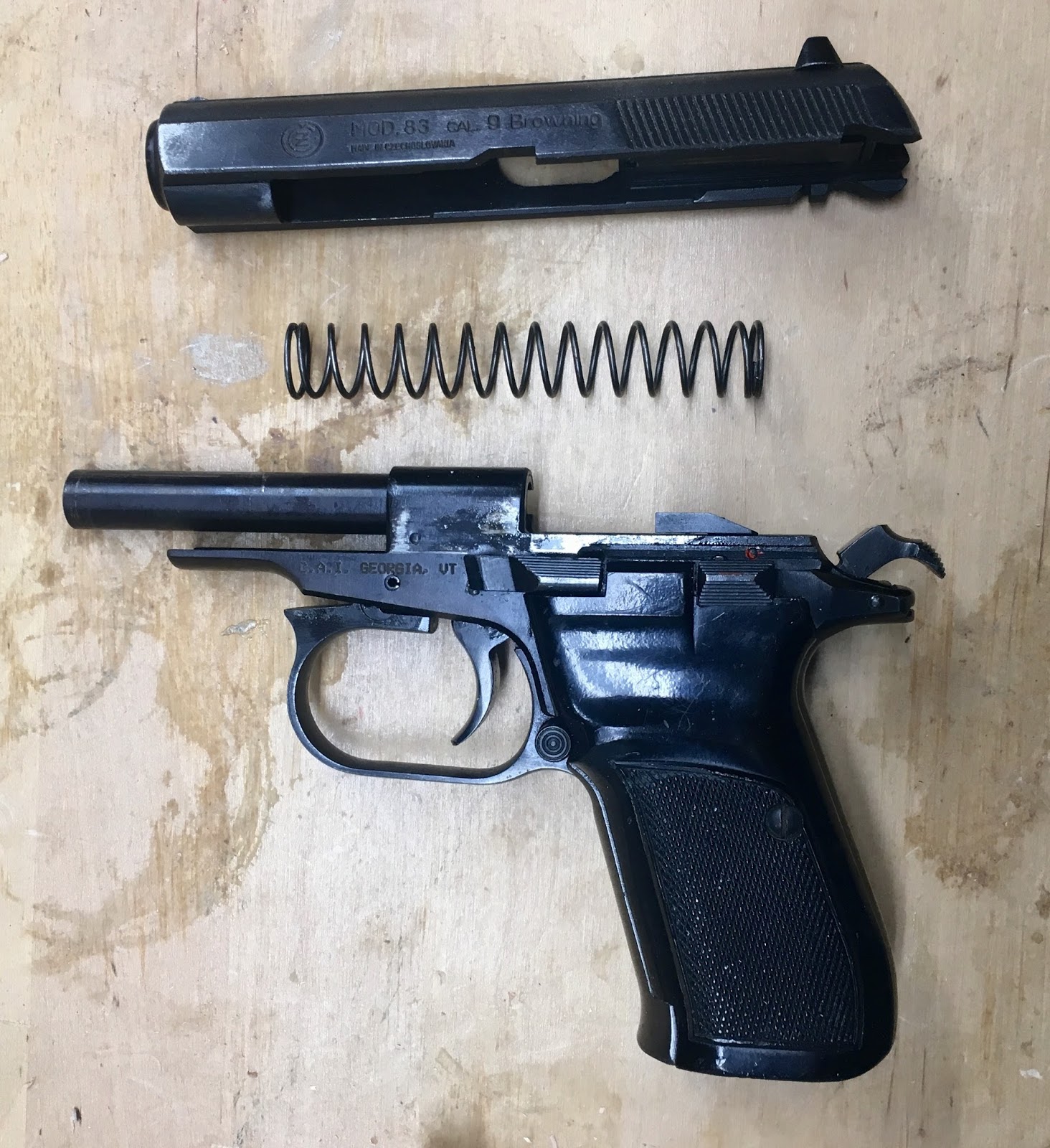
Disassembly is very much influenced by the Walther PP/PPK- after removing the magazine and clearing the gun, you pull down on the front of the trigger guard. This takes significantly more effort than on the Walther guns, but when pulled down it locks into position with a solid and satisfying  click:


With the guard pulled down,  the slide can be pulled back, lifted up at the rear, and slid forward off the rails as with the typical blowback pistol:


Next: Shooting the CZ83