Friday, June 17, 2011

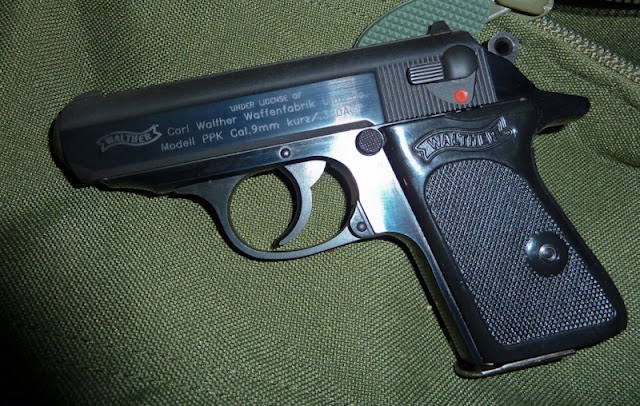
The Walther PPK

I

As any real James Bond fan knows, this is the gun that Q equipped 007 with after he was forced to give up his mouse pistol- a Beretta .25. This wasn't much of a step up, by modern standards; the .25 ACP develops around 65 foot-pounds of muzzle energy, and the .32ACP used by the original PPK comes in at 123 foot-pounds. Yes, it's twice as much as the .25ACP, but the .380 ACP, which this gun is chambered for, develops around 200 foot-pounds of ME, or almost twice as much again.

I admit that the Bond connection did play some role in my selection of this pistol, but my main reasons for choosing it had more to do with reliability, accuracy and safety. I was looking for a replacement for the S&W 442 that was more accurate, easier to control, and if possible, just as reliable. I was also looking for a gun with a safety- the gun should be difficult or impossible to fire if it's picked up by the wrong person, whether it's someone trying to do you harm, or a careless child or adult.  Yes, there are people who on picking up a gun will pull the trigger to see if it's loaded, as I noted in a previous entry.

I chose .380 as it develops as much ME as does a .38Spl in a snub nosed barrel, and there are a lot of .380 guns to choose from these days. Most of them are double action only (DAO) though, and almost none have a safety. I wanted a gun with double action, so it didn't have to be carried cocked and locked (should I decide to carry it), and one with a positive safety, for reasons already mentioned.  That still left a few guns, but I also limited myself to the top quality makes. Saving a few hundred dollars on the purchase of a gun doesn't mean much when it misfires at an inopportune time.

I looked at two from SiGARMS, the P238 and the P232. The P238 is a downsized Colt 1911, and while it's a very high quality gun, it's single action, which means, like the 1911, it has to be carried either cocked and locked, or with an empty chamber. The P232 is a modern double action guns, with a de-cocking lever, but no safety. Uncocked, with a round in the chamber, it only takes a pull of the trigger to fire.

That left the PPK. Interestingly enough, the PPK- or rather, the PP, which preceded it- is really the father of almost all modern double action autos, dating back to 1929. Every double action gun since then owes a debt to the Walther. What particularly appeals to me is the integrated safety/decocking lever. Put the safety on, and rack the slide. It'll load a round, and then drop the hammer on a hammer block. Pull the trigger, and nothing happens. Flick the safety off, and now when you pull the trigger it'll fire. This is second nature with a little practice, but should slow up someone not familiar with the gun.  Once fired, it will continue to cycle and fire in single action mode. Flip the safety/decocking lever, the hammer drops on the hammer block, the trigger is locked, and it's in safe mode again.

Importation of the PPK was banned by the 1964 GCA as it was just a little too small to meet the (arbitrary) standards set by that law. Walther responded by creating the PPK/S, which combined the shorter barrel and slide of the PPK with the longer grip of the original PP. Today, all PPKs and PPK/Ss are made in the US by S&W, under license from Walther, so the size is a non-issue. The PPK/S is the more popular model, probably because it fills the hand a bit better, and you can find more accessories, like aftermarket grips, for it. (Or maybe you can find more accessories because it's more popular)

Another nice feature of the PPK is the fixed barrel, a consequence of the straight blowback design. While this doesn't absorb recoil energy as well as the delayed blowback design used by most modern autos, it is somewhat more accurate. Not that you're going to be shooting bullseye competitions with a PPK, but 4" groups at 25 yards are better than 8" groups.

Having been designed for the .32ACP, the PPK in .380 does bite a bit, and as noted, no one's making rubber aftermarket grips for it,. There's a simple enough solution, though. Cut a 3" section of bicycle tire innertube and slip it over the plastic grips. That will provide a non-slip grip while still protecting your skin from the serrated teeth on the hard plastic grip. (I later replaced the plastic panels with a great looking set of walnut panels from Altamont.)

If you find yourself shopping for a PPK or PPK/S, be advised that some of the early models made by S&W suffered from a very serious defect- engaging the decocking lever could result in the gun firing! Check any used S&W PPK or PPK/S against the serial numbers at Smith & Wesson's web site. If the gun in question falls into that range of numbers, look for a center punch mark  on the frame behind that hammer- that's how S&W marks guns returned to the factory for modification.


Update: I eventually sold the PPK, as it was very unpleasant to shoot. I replaced it with a Ruger LCP that is smaller, lighter, and much more comfortable to shoot. 

Friday, March 25, 2011

The Ruger Blackhawk


The Ruger Blackhawk was the gun that reintroduced single action revolvers to the shooting public. Sure, Colt had periodically made their Single Action Army on and off since it was introduced in the late 19th Century, but the Ruger was the first modern single action- though that does sound like a bit of a contradiction.Single actions seem like a curious affectation to many; why not buy a double action revolver? After all, you can still fire it single action, if you like. But a single action is a simpler design, with a lot less to go wrong. And it's a connection with history.

My first single action Ruger was their percussion version, the Old Army, in stainless steel. I bought it in stainless as I figured it would be a lot easier to maintain, and it was; just pop off the grips and put it in the dishwasher. (Seriously!) But in stainless it just didn't look right. I know stainless steel guns are more practical, and increasing in popularity, but I like blued guns- particularly when it comes to classic designs.

I'd sold the Smith and Wesson 442 that I wrote about previously which left me with a lot of .38 special cartridges and reloading components and no way to shoot them. I could have sold them as well, but the .38 and its big brother the .357 are just about the most versatile cartridges out there. You can buy one gun that shoots both, and buy or load ammunition ranging from mild wadcutter target loads up to heavy  magnum loads suitable for hunting deer and large razorbacks. 

A few weeks after selling the 442 I visited a small mom-and-pop gun shop to look at a single-shot Anschutz rifle (more on that later) when I spotted a Blackhawk in .357 with a 6.5" barrel. To me, this is just about the perfect length; long enough for good accuracy and reduced muzzle blast, and still short enough to carry in a holster afield.  Sure, you can't do quick draws the way you can with a 4" barrel, but I'm not into Cowboy Action shooting.

I spent some time checking the gun out. It showed signs of use, but no dings or other obvious damage. Bore and cylinder? Clean, no signs of erosion. No gas cutting in the backstrap. Cylinder didn't wobble when turned. Locked up solid when the gate was shut. We negotiated a bit on price and came to a mutually agreed upon figure.

So far I've only had it to the indoor 50' range, where it did a fine job grouping the commercial Winchester white Box .38 Specials and the old .38 wadcutter handloads I had on hand. I'm anxious to take it outdoors when it warms up, and see how it does at 50 yards shooting off a rest. Might even take it deer hunting one day.

Thursday, February 3, 2011

Spanish Side by Side Doubles


If you've always admired the beautiful English double guns, but can't budget the $25,000 or more that even the plainest of these costs, you might want to look at a Spanish gun- an engraved gun like this AyA sidelock 20 gauge can often be found for as little as $4,000, and plainer box locks for even less. The gun pictured belongs to a friend of mine, who sold me his previous gun 15 years ago when he found this gun fit him better.

  
I think he paid about $3,000 at the time, which is certainly a bargain for a hand fitted, hand engraved gun in a custom fitted leather case. But there are a still lot of deal out there to be had. 

Light doubles are just about perfect for upland game hunting, which is what we mainly do around here. Barrels are chocked open and improved cylinder, which makes them perfect for 10-30 yard shots (though I've dropped birds at 40). The short swing length and light weight  make it easy to bring the gun up quickly at a fast moving pheasant or partridge. Light loads are the rule- 3/4 or 7/8oz of plated #6 pellets in a 20 is the perfect load for pheasant at close range.

If you're not pass shooting at ducks and geese there's little reason to carry a heavy auto or pump loaded with 12ga 2-3/4" or 3" magnums. You may have read that British shooters typically use 12 gauge guns for upland shooting, and that's true, but many of those guns- particularly the older ones- have 2-1/2" chambers and are loaded to 1oz or less; their upland 12ga. loads are pretty close to our 20ga. loads.


Airguns for Pistol Practice


I'm a great proponent of airguns- not just for simulated firearms practice, but for shooting in their own right. I shot Airgun Field Target for several years,  I have an airgun blog, and I use air rifles for small game hunting. The gun shown above, though, I bought specifically for firearms simulation and training. It's a Makarov replica, and it's very close in size, design, and weight to the actual gun.

This is the second version of the Makarov BB pistol made. The first was made in the same Russian factory that produced the Makarovs, and was dreamed up as a way to use up the surplus frames and other parts after production of the pistol was discontinued. It was not a cheap gun, selling for over $100, but it was probably the best BB pistol ever made. It was so much like the firearm version that the BATF decided it could be converted into an actual pistol without too much effort (though I don't know that this ever actually happened)  and so after two years of production it was banned. If you can find one, expect to pay at least $200 for it.

The Umarex-made Makarov CO2 BB Pistol air pistol replica seen above sells for a more reasonable $59, and has a working slide and safety lever that closely mimics the functioning of the firearm. Pulling back the slide cocks the hammer, and the safety locks the gun so it can't be fired or cocked. BBs load via a magazine that slides into the grip, just like a magazine on the real gun. If the hammer isn't cocked, it fired with a realistic double-action trigger pull.

If you're just getting started with pistols, or introducing a family member to shooting, something like this is a good way to teach safe gun handling at home, with low risk of injury. Eye protection and a good backstop are still necessary, of course.