Friday, June 2, 2017

The Burris 4x Mini


I hesitated a bit before posting this as the Burris compact scopes aren't well known, but the word does seem to be getting out, as prices have been rising lately. I currently own three: A 6x mini with adjustable objective that's mounted on my Theoben Sirocco, and two fixed objective 4x minis, like the one above. This one cost me $150, with shipping, and the previous one I purchased last fall cost $125. The 6x AO scopes have been trading for $275 and up on eBay.  There's also a 3-9x fixed objective mini, and a 4-12x AO mini. 

There's a real craze these days for high powered "Sniper" scopes with magnifications as high as 32x or 40x, but for most uses it's overkill. There are instances in which you need high magnification, i.e., in which the target is very small, or it's a high precision event, like bencherest.  (I shot airgun field target with a 6-18x scope, and that's a game where you need to keep your pellets inside of 3/4" at up to 50 yards. Some guys used fixed scopes up to 40x). But for hunting and most recreational shooting, unless you're a varmint under taking our groundhogs at 600 yards, more modest magnification is called for. When I started shooting in the 1960s most scopes were in the 4-6x range.

4x is, I think, the best all-around magnification for .22s,  deer rifles East of the Mississippi, hog rifles, and the like. They give you fast target acquisition, a wide field of view, and more than enough accuracy for hunting. The 20mm objective on this scope looks tiny, but it's more than big enough- a  20mm diameter objective divided by 4x magnification  yields a 5mm exit pupil (the size of the bundle of light exiting the rear of the scope into the user's eye) which is more than enough for daylight use. In fact, the U.S. Army determined sone years ago that a 5mm exit pupil was ideal. Your pupil isn't going to get any bigger than that in daylight. [For some reason most fixed 4x scopes today are 4x32, which makes no sense. That gives you an 8mm exit pupil, and even the youngest shooters don't have pupils that big, except maybe after an hour in  a completely darkened room.]

Burris scopes are extremely well made, with thick wall tubing and excellent glass, and Burris still services every scope they've ever sold. They'll even adjust the parallax. The 4x and 6x non-adjustable minis have the parallax set at 100 yards, I believe, but they'll set them to 40, making them excellent .22 scopes.  If only they'd bring back the minis, I bet a lot of shooters would happily fork over the dough to buy one.

Caldwell Stinger Rifle Rest


Caldwell makes a lot of different rifle rests, from sand bags on up to their Rock BR Competition bench rest. I have a Rock BR that I've modified, according to ideas gleaned from on-line bench rest fans, adding nylon bushings and thrust bearings to reduce stiction and play. It's a lot of rest for under $200, especially when compared to the $500-1000 rests from Sinclair and Ransom that many serious competitors use. This rest- the Stinger- falls in the middle of their range. It's designed for sighting in rifles, and it's particularly well suited for AR-type carbines, though it'll fit just about any rifle. 


Vertical adjustability is good, although obviously not as good as on the Rock BR. There's a coarse adjustment up front, under the forearm rest:


...and a fine adjustment in the rear:


Unfortunately there's no traversing adjustment, so you're left with nudging the butt to effect any left-right corrections. But it's a good, solid, rest for zeroing in at hunting distances, it'll accommodate most any rifle, and for around $100 at Amazon it's a pretty reasonable deal. 

If you want a serious bench rest at a budget price, Amazon has about the best price on the Rock BR and you can find some excellent ideas for customizing it here.  


Friday, April 28, 2017

The Polish P83 Wanad in 9x18 Makarov - Part II


In my last post on the P83 Wanad three months ago I talked about the gun itself, its history, and how it disassembles. Today I finally managed a trip to the range with the pistol (and a few others). As you can see above I took a few boxes of Geco 9x18 Makarov ammunition that I chose in part because it was the cheapest I could find. After all, a reliable pistol designed for combat use shouldn't be picky about ammunition- and this one wasn't picky. Every shot fed and ejected perfectly. As to accuracy...

Fixed barrel pistol like the P-83, P-64, and Walther's PP family are (or should be)  intrinsically more accurate than delayed recoil pistols like the John Browning designed 1911 pistol. In a 1911, the barrel  moves rearward and down with every shot, and depends on the mainspring and the tight fit of the moving parts to return to its initial position. Tiny difference in position on successive shots  can make a big difference downrange, which is why the gunsmiths who tune the 1911 for bullseye competition spend most of their time tightening up all the tolerances and polishing barrel bushings. The fixed barrel on the P-83, on the other hand,  is in exactly the same position for every shot.


The target above was shot outdoors at 50'. It was a moderately windy day, around 66 degrees. My first shot missed the target entirely. You can see a few shots on the bull,  a few below, and many more high and to the right. The gun was shooting about a foot low and 8 inches right at 50', and I had to walk the shots onto the bull, starting in the upper right corner of the silhouette target. That's not really a big issue as the sights can be moved or filed. I'd like to get it shooting to point of aim at 25 yards.

Firing behavior was sharp, but not terribly uncomfortable. My hands weren't at all sore after 50 rounds fired slowly over half an hour. Double action is heavy but smooth, and single action is light and crisp, with no creep at all on my sample. The safety/decocker is difficult to reach, but the heavy DA pull means that this pistol, like the PPK, can safely be carried uncocked with the safety off.  The grips look and feel rugged enough, but their shape doesn't make it easy to get a good, repeatable, hand position. I'm thinking of ordering a set of wood grips ($69) from Grips4U.net, where they have wood grips for 122 different classic European and American pistols.

On the whole I like this pistol a lot. It's very reliable, and ammunition isn't expensive- the Geco can typically be had for $15-16 a box of 50, and the steel cased Russian Brown Bear and Silver Bear can usually be had for for between $8 and $9 for a box of 50.  Its good enough to be issued to Russian troops, so I assume it's reliable. The P-83 is not only reliable enough to use as a carry piece, it's also a great historic collectable, and I suspect the price will go up when the current supply runs out- remember when Nagant revolvers were selling for $119? Next time out I'm going to work on zeroing the sights and then I can test for accuracy.

Friday, January 27, 2017

The Polish P83 Wanad in 9x18 Makarov - Part I

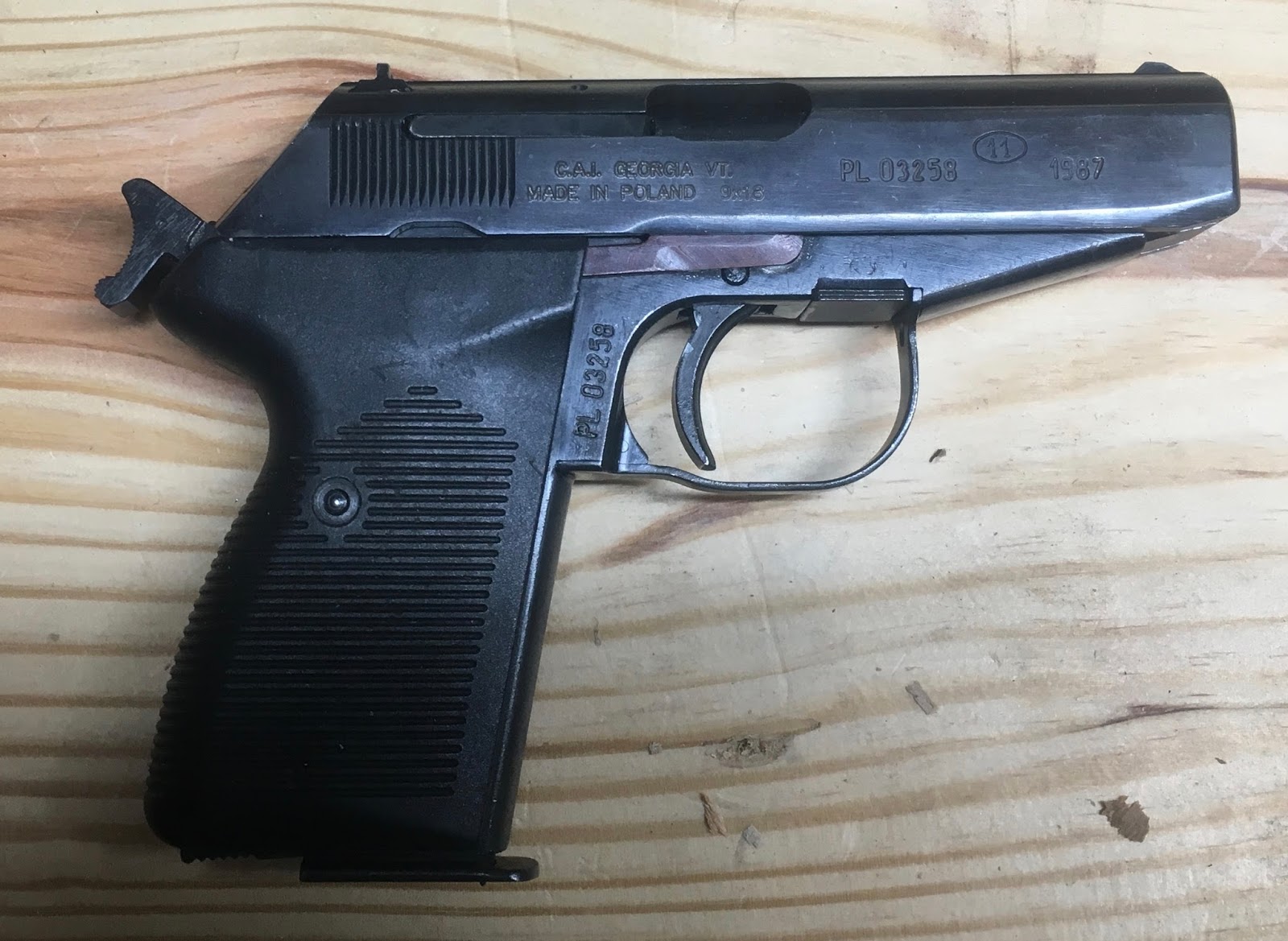
There has been a good supply of Polish made P83 pistols in the last year or so, and I've been contemplating getting one as they're  very inexpensive- $219 from most distributors. What finally convinced me was the thought that there's not an infinite supply of the out there, and when the current supply runs out (which granted may not be for a while) the price will be going up. Consider that when I bought my 1947 Nagant revolver they could be had as cheaply as $99 from the C&R dealers, and now they sell for $250 to $300. I found mine at Gander Mountain for $229, plus $25 shipping, which is about what would cost if I'd ordered from the distributor and had it shipped to a local FFL.


Mine arrive in well worn but, it appeared, mostly unfired condition. The bore is nice and shiny. There are a lot a shallow scratches but the only appreciable wear to the bluing is right around the muzzle, which is exactly what you expect to see on a gun that has been repeatedly unholstered and reholstered without being fired. 

]

So what is a P83?

In 1958 the Poles needed a new sidearm for the police and military, and as a client state of the USSR that meant whatever they chose had to chamber the Soviet standard 9x18 Makarov cartridge. Unlike the Bulgarians and other client states, they didn't license the standard Makarov pistol design. Instead, they designed their own pistol, called the P64. It was a beautiful little pistol, with all machined parts, and it was very expensive to make, so in 1983 they replaced it with the P83. 

Like the P64, the P83 is heavily influenced by the design of the Walther PPK. It's a straight blowback design with a fixed barrel that is double action on the first shot, and single action on successive shots.   Unlike both the PPK and the P64, the P83 made largely of stamped and welded pieces. It's also significantly larger; take a look at the P38 next to a modern PPK/S in .22: 


 It may not be as elegant looking at the PPK or the P83, but it's a rugged, reliable pistol. Let's take a closer look at some details.


The magazine release is the typical European heel release. It's easy to operate, and magazines are firmly elected thanks to a spring above the magazine. There's also a feature seen on many if not most military sidearms: A ring for a lanyard.

Another interesting feature of the P83 is its loaded chamber indicator- the recessed pin seen above the safety/decocking lever:


It's a pin that sticks out when there's a round in the chamber- like this:


How it works is very simple. If we look at the other side of the gun, we see an unusually long extractor:


The extractor rotates around a pivot about midway along its length. When a cartridge is chambered, it pushes the front part of the extractor out a fraction of an inch, which pushes the rear half inward- which in turn pushes the loaded chamber indicator pin out the other side. Simple. 

I mentioned that the P83 is heavily influenced by the PPK, and that's clearly visible in the safety/decocker lever. But the P83 safety works in a very different manner. Like the PPK, pushing the  lever to the safe position drops the hammer without firing the gun. In the PPK, that also rotates a large internal block that stops the hammer short of striking the firing pin. In the P83, it performs two different functions. First, it blocks the firing pin from moving. But it also prevents the hammer from striking the firing pin in a clever manner.

Note the position of the firing pin in a gun with the safety off:


When you activate the safety/decocking lever, this happens:


Note that the firing pin has tilted downward. How does that keep the gun from firing? 


As you can see, there's a recess in the hammer. If the firing pin is in the down position, the it fits into the recess and is not struck by the hammer. Even if something strikes the firing pin, it's still locked from moving. 

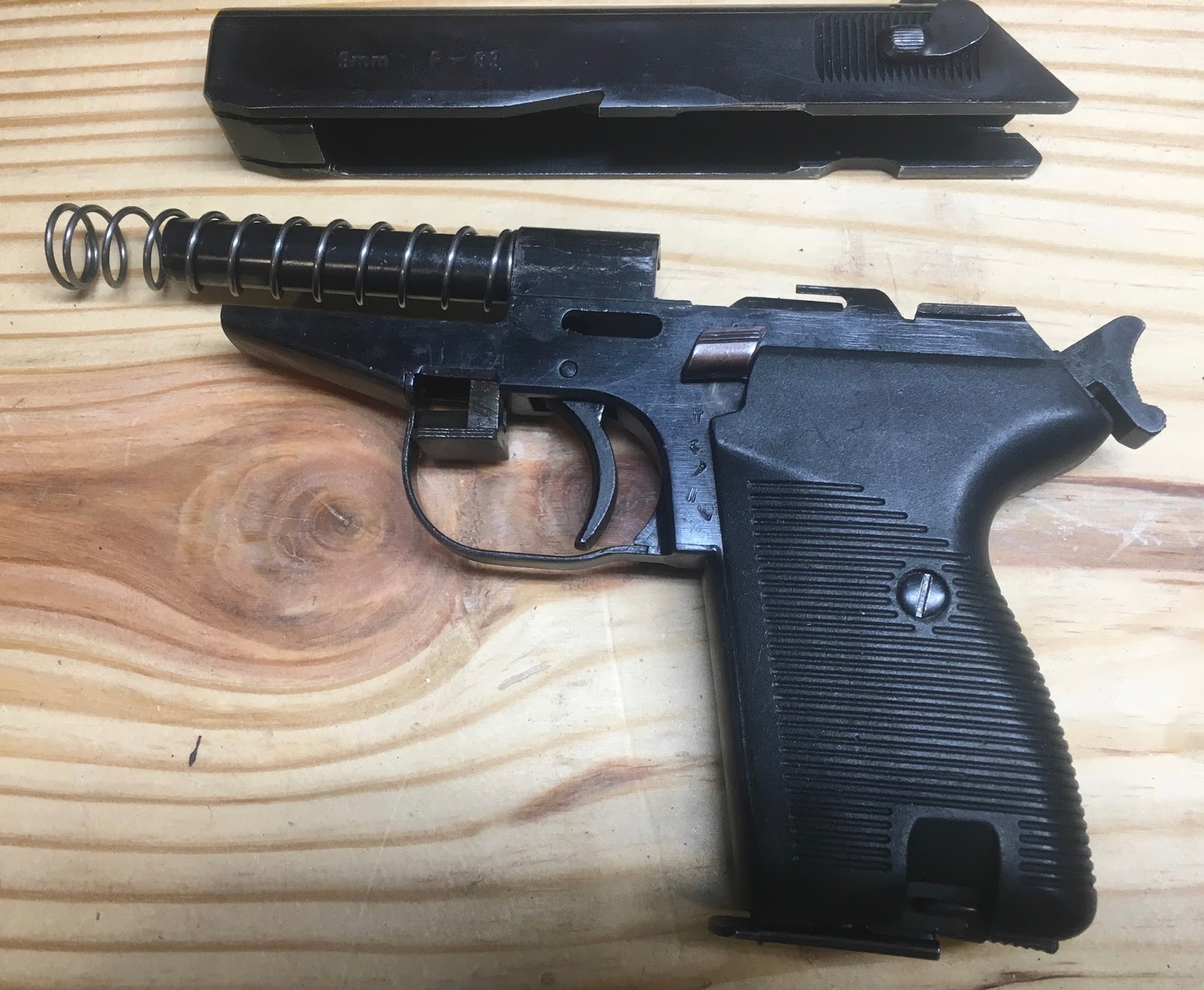
Disassembly is similar to most fixed barrel, straight blowback pistols: Unlock the detent that keeps the slide on the receiver when it recoils, pull the slide back, and remove. On the PPK, you do this by pulling down the trigger guard, which is a very elegant design feature but a bit clumsy in practice. On the P83, there's a detent mounted just above the trigger guard:


To release it, just pull it down:


And pull the slide back and off in the usual manner:


In Part II, i'll discuss the firing behavior of the P83. But that will have to wait for warmer weather and a trip to my club.