Wednesday, May 13, 2015

High Standard Duramatic M101: First impressions


While most of my collection consists of revolvers, I have long been a fan of the old High Standard pistols, which combined solid steel construction with great reliability and accuracy. While I'd like to find one of their high end competition pistols at an affordable price,  I'm no less a fan of their lower end pistols- like this Duramatic M101 that caught my eye at the local Cabelas. This is one of the cheapest High Standard .22s, but it's just as solid and well made as the better guns, and it came with the original box and all the original paperwork. I managed to negotiate the price down $50 from the asking price (it had been there for a while) and it followed me home.


This pistol is very well designed, with a lot of attention given to service and maintenance. The safety is a simple cross bolt, located in the rear of the receiver, that performs several functions. 


See those two notches in the slide? The rearmost one is engaged by the cross bolt when the slide is forward, locking the slide in place. The forward notch is used for locking the slide open, as you see in the photo above.

Once the slide is locked open, turning the large wheel in front of the trigger guard loosens the screw holding the barrel in place. This is very different from just about every other HS pistol, which all used a push-button barrel release, like the S&W 41 and 23A.


One the barrel is removed, the slide can be removed by simply sliding it forward:


Note that the striker/firing pin is in the fully cocked position, held in place by the sear; locking the slide back also cocked the striker. Don't touch the trigger while the gun is disassembled unless you want to see the striker shoot forward with a lot of force! (I accidentally did that the next time I had the gun disassembled for cleaning. Now I put the safety back on after moving the slide.) The rear end of the striker is painted red, and protrudes slightly out the back of the receiver when cocked, giving a nice visual indication.


Once the slide and barrel are off you can loosen the trigger guard retaining screw (just a few turns are needed) and the screw that holds the grip in place and remove the grip. At that point you'll notice that there's no metal grip that's part of the frame; the plastic grip is both the band grip, and the support for the magazine! I like to remove it when cleaning the gun as I'm concerned that some of the solvents used in cleaning might attack the plastic. (If you do manage to damage the plastic grip, all is not lost; modern replacements are being made from the original mods and can be had for $50 or so.)


I brought the carefully cleaned, lubed, and reassembled gun to my club this morning, early enough that I had the indoor 50 foot range to myself for several hours, so I was able to do testing at distances from a few yards to the full 50 feet. I used several different standard velocity .22LR cartridges, including CCI Standard Velocity, Federal Match, Federal Auto Match, Aguila Pistol Match, Wolf Match, SK Match, and Aguila SSS 60gr. The gun functioned flawlessly with everything for the first hundred or so rounds, but as it got dirtier some of the rounds didn't feed as well, and the bullets hung up on the feed ramp. 
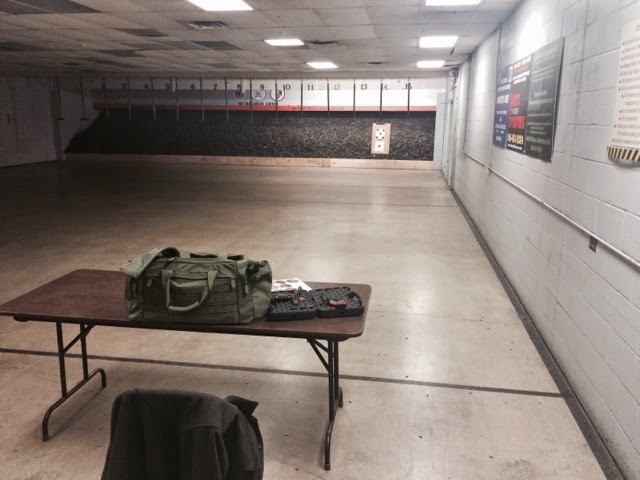


Accuracy was hard to judge, as the gun shot several inches high at 50' with the ammunition I was using. The rear sight is a battered-looking thing with no adjustment, so I was stuck with that for the moment. It did seem to group reasonably well; I plan on going back with more targets and a brass hammer and punch so I can move the rear sight. I might even find a small adjustable sight I can install.


I have to say I really like the feel of this gun. The all-steel construction goes it a feeling of solidity and mass you just don't see in many other .22 auto pistols. Shooting it made me think I might want to get one of High Standard's actual match pistols, and that started me looking around. What I found will be in the next blog entry.

Postscript: Six months after buying this pistol I sold it. I was tempted to keep it, as it's a beautiful example of the kind of design and solid construction you simply don't see in modern pistols, but I only have so much room.  I also have a really nice High Standard Supermatic Citation now that's the most accurate and the best shooting pistol I've ever owned.

There is one  modern pistol that's built the way they used to be built, and that's because it's the grandfather of all modern auto pistols: The 1911. The best ones still have that solid feel and give the impression that they were milled from a block of steel- because they were. I've never owned a 1911, but I've always wanted either a standard Government model or a serious wadcutter target model.


Sunday, May 10, 2015

Custom Ruger 10/22 Part V: First Range Tests


In the last installment (Part IV)   I described the installation of a modified trigger assembly, my final mod to what began as a stock slightly used 10/22 purchased at Gander for $207. With warm weather having finally arrived, I took the gun and a selection of .22 ammunition to my club for some long awaited testing. Is my $478 project gun as good as, or (hopefully) better than the $550 Ruger target version?  The first thing I discovered was why everyone was selling the BSA Sweet .22 scope so cheaply- it's just not very good. I was not able to dial out all of the parallax in this scope, which meant my results were not reflective of shat this rifle is actually capable of. I also discovered that while a 3-9x scope is perfectly adequate for hunting with a .22, it's not not really adequate for critical accuracy testing. 

First group (Federal Auto Match) was almost 2". That's around 4MOA:


Not what I expected after all that work, but the new barrel had only had a dozen shots through it, and I was still struggling with the parallax error. I changed my grip, and tried to view the scope the same way every time to reduce the parallax:


Once I got settled in with a consistent position, to minimize parallax, most of my groups looked like this one (above), which was 3/4" in size. That works out to 1.5 MOA, which isn't too bad, but I'm betting I can so much better with a better scope.

I tested Federal Auto Match, Aguila Rifle Match, CCI Standard Velocity, and Wolf Match; the Wolf gave the best groups, like this one, which measured 5/8", or 1.25 MOA. Getting there, but still short of what I think it can do:


Vertical dispersion on that 5 shot group is only 3/8", or 0.750 MOA. That gives you an idea of what this rifle might be capable of. Weather permitting, I'm going to try again this coming week with a BSA 6-24x44 scope I picked up at a swap last year, but I should probably buy a new scope. The obvious choice is a T36 Weaver, but I'm going to see what the BSA can do first.

Thursday, April 9, 2015

The Return of M6 Survival Rifle


The M6 Aircrew Survival Weapon was USAF issue from the 1950s until the early 1970s. It was a simple over/under, with a .22 Hornet rifle barrel over a .410 smoothbore barrel and was intended, as the name implies, as a way for aircrews to harvest wildlife in a survival situation. They're rarely seen in the private marketplace, in part because the 14" barrel means they're regulated as an AOW (Any Other Weapon) by the BATF, and that means not only is BATF permission and paperwork is needed to transfer ownership, but until recent a $200 transfer tax had to be paid as well.

A number of companies produced civilian versions o the M6 between the 70s and 2008, with Springfield Arms being the last that I'm aware of. Springfield also produced a pistol version, which I wrote about not long ago. I've long wanted one, but never got around to buying when they were available. Now Chiappa Arms, makers of a wide range of curious arms (like their Rhino revolver)  has produced two versions of the M6 design as well as an interesting multi-caliber package. Compared to the Springfield design, the Chiappa M6 adds a more sophisticated trigger guard and three separate Picatinny rails.

The basic M6 is available in .22/20 gauge or .22/12 gauge. (I'd prefer the original .410 version made by Springfield arms, but at 6lbs the Chiappa is probably heavy enough to damp the recoil from reasonable 20 and 12 gauge loads.)  The multi-caliber version, called the "X-Caliber," consists of the .22/12 version along with a series of steel inserts for the shotgun tube that allow you to use eight pistol calibers (.380 , 9 mm , .357Mag/.38SP , .40 S & W, .44 Mag, .45 ACP , .410/.45colt ) and two shotgun shell sizes (410 ga, 20ga). I'm not sure how practical the pistol cartridges are, as the point of aim would be different for every cartridge.

So how much does this all cost? Slickguns.com has the standard M6 models at $438.99, and the X-Caliber for $614.19. To that, add shipping, sales tax,  and FFL fees, and you're probably at around $500 and $700, respectively. I still want one... but not enough to spend $500.

Wednesday, April 8, 2015

Herrett Nationals bullseye stocks for the Ruger Mk-III


The last time we saw this gun (Ruger Mark-III Hunter) it was sporting a set of Volquartsen molded plastic grips and a silver Ultradot sight. I sold the Ultradot as I was shooting this pistol with iron sights, but recently I mounted another dot sight (Millett SP-1) and purchased a set of Herrett Nationals grips. These can be a bit hard to find; not many retailers carry them, and Bullseyegear.com has had them on back order for a long time. But I found a set at a good price ($69 + $5.95 shipping) on eBay and they arrived a few days ago.

I took the newly configured pistol to my club yesterday and spent about an hour on the 25 yard outdoor range with the Herrett-equipped Ruger and a box of the Federal Auto Match I bought at Field & Stream last week. First impressions are that these grips are definitely easier to hold steady than most previous grips I've tried. The palm self makes it easier to get a solid grip without excessive gripping force that can make the hand tense up. A light squeeze in the grip causes the hand to push down on the shelf, which pushes the muzzle up.

The screws that hold the shelf in place are not as secure as I'd like; I may add some star washers, or perhaps a couple of pins to better secure the shelf. But overall I like it. My XL-sized hands require that the shelf is set almost at the bottom of its travel. Those with hands significantly smaller than mine have reported that they can't set the shelf high enough for a good grip, but some small handed target shooters have added padding to the shelf to fix this.

As for the Federal, it all fed without any problems (I fired around 100 rounds). I can't give any real reading on the accuracy, as it was pretty windy that day. I plan on shooting some indoors from this gun next week, and that should give me a better idea. Reports from other shooters say it's a lot more consistent than most bulk-pack .22LR, but certainly not up there with the low end match ammo like Ely Club; it might be in the same class as good old CCI Standard Velocity. I'll reserve some for comparison with other ammunition in my Anschutz and my custom 10/22.